Twenty-second Sunday in Ordinary Time (C), August 31, 2025
The Humble Heart: Gateway to Heaven
Sir 3:17-18.20.28-29, Psalm: 67, Heb 12:18-19.22-24a, Lk 14:1,7-14
My dear sisters and brothers in Christ,
Today, the Word of God presents us with a profound and beautiful paradox: the path to exaltation is descent into humility, and the way to encounter the divine is through the grace of a humble heart. Our readings weave together a tapestry of wisdom, urging us to embrace the virtue that lies at the very core of the Gospel: humility.
The book of Sirach offers us fatherly advice, a gentle guide for navigating our relationships with God and one another. “My child, conduct your affairs with humility,” it begins, “and you will be loved more than a giver of gifts.” In a world that often prizes self-aggrandizement, this is counter-cultural wisdom. Humility is not about thinking less of ourselves; it is about thinking of ourselves less. It is the clear-eyed recognition of our true place before God—creatures, lovingly made, yet entirely dependent on our Creator. “The greater you are,” Sirach continues, “the more you must humble yourself; so you will find favor with God.” This is the key that unlocks the door to God’s heart. It is the disposition that allows His grace to flow into us, for as St. Augustine profoundly said, “It was pride that changed angels into devils; it is humility that makes men as angels.”
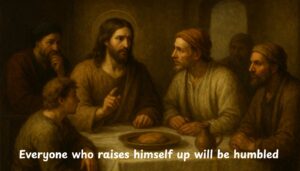
This theme is taken up and made incarnate in the Gospel of Luke. We find Jesus at a Pharisee’s dinner, observing the guests jockeying for the places of honor. He responds not with scorn, but with breathtaking wisdom, offering a parable that reveals the very order of His Kingdom. “For everyone who exalts himself will be humbled, but the one who humbles himself will be exalted.” Jesus is giving us more than mere social etiquette; He is unveiling a fundamental law of the spiritual life. God’s economy operates on a different currency. The way up is down. The one who serves is the greatest. The King of Kings entered the world not in a palace, but in a manger, and He left it not on a throne, but on a cross. This is the ultimate humility.
And then He turns to the host, challenging him—and us—to radical charity: invite not those who can repay you, but “the poor, the crippled, the lame, the blind.” Why? Because true love expects no return. It reflects the unconditional love of God Himself. This is the practical outworking of humility: seeing the inherent dignity in every person, especially those the world overlooks, and serving them for Christ’s own sake.
But where does this path of humility ultimately lead? The Letter to the Hebrews answers with a glorious vision. It contrasts the terrifying, inaccessible majesty of Mount Sinai with the breathtaking beauty of what we, through Christ, have approached: “Mount Zion and the city of the living God, the heavenly Jerusalem.” We have not come to a blazing fire and trumpet blast, but to a joyful assembly, to God Himself, “and to the sprinkled blood that speaks more eloquently than that of Abel.”
This is our destination! The humility we practice is not for its own sake. It is the necessary preparation of our hearts to enter this heavenly reality. The pride of the guests at the banquet closed them off from others and from true joy. Humility, however, clears our vision. It allows us to perceive, even now, the heavenly reality that surrounds us. We are already part of that “assembly of the firstborn enrolled in heaven.” We are already in the presence of “the mediator of a new covenant,” Jesus. A proud heart is too full of itself to perceive this glory. A humble heart, empty of self, has room to be filled with the awe-inspiring presence of God.
So how do we apply this in our daily lives? It begins with small, conscious acts.
- In our families: Do we seek the last word, or do we listen with patience? Do we insist on our own way, or do we defer in charity? Let us live by the advice of Sirach to “humble ourselves” in the little things at home.
- In our communities: Do we seek recognition, or do we serve in hidden ways? The next time we are at a meeting, a family gathering, or even in the church hall, can we choose the lesser seat? Can we be the first to welcome the newcomer, the one who seeks out the person sitting alone?
- In our prayer: Do we come to God with a list of demands, or do we first come to listen, to adore, and to thank? Humility before God is the foundation of all prayer.
Pope Francis often reminds us that “humility is the virtue of the saints.” It is the sure path to peace, for it frees us from the exhausting tyranny of having to prove ourselves. It is the source of spiritual strength, for when we are weak and acknowledge it, then we are strong, because God’s power can finally work through us without obstruction.
Let us go forth from here today, asking the Lord for the grace of a truly humble heart. A heart that seeks not its own glory, but the glory of God. A heart that sees itself truthfully, loves others generously, and so becomes a fitting dwelling place, ready to join the everlasting banquet in the heavenly Jerusalem. Amen.