
Monday of the Twenty-second Week in Ordinary Time, September 1, 2025
The Hope of the Prophetic Word
1Thess 4:13-18, Psalm: 95, Lk 4:16-30
My dear sisters and brothers in Christ,
In our scriptures today, we are presented with two powerful scenes that speak to the deepest realities of our human experience: our encounter with grief and our encounter with rejection. And into these realities, the Word of God speaks a word of profound hope and challenging truth.
Saint Paul writes to the Thessalonians to address a pastoral concern. Some among them are grieving, worried about their loved ones who have died before the Lord’s return. They fear these departed souls might miss out on the glory to come. Paul’s response is not one of harsh correction, but of tender comfort. “Do not grieve like the rest, who have no hope,” he urges. He offers them a breathtaking vision of the end times, where the Lord Himself will descend, and the dead in Christ will rise first. This is our Catholic hope—not a vague wish, but the assured promise of the resurrection, secured by Christ’s victory over death. We grieve, yes, for we feel the painful absence of those we love. But our grief is transformed because it is anchored in the certainty of the reunion to come. As Pope Benedict XVI beautifully stated, “Whoever believes in Christ knows that death is not the end.” This is the comfort Paul offers: the promise that life, not death, is the final word for those in the Lord.
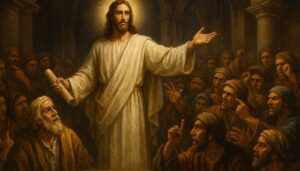
This hope, however, is not a passive waiting. It is active and prophetic, and it often exacts a cost, as we see in our Gospel. Jesus, in His hometown synagogue, reads from the prophet Isaiah and declares that this Scripture—promising liberation, healing, and favor—is fulfilled today, in their hearing. Initially, they are amazed. But when His message challenges their preconceptions and extends God’s grace beyond the boundaries of Israel to the Gentiles, their amazement turns to fury. They reject the prophecy because it disrupts their comfortable worldview. They wanted a Messiah for themselves, not a Savior for the whole world.
This reveals a difficult truth: the Word of God is comforting, but it is not comfortable. It is consoling, but it is also challenging. It calls us to a hope that can span beyond the grave, but it also calls us to a love that spans beyond our own circles, our own prejudices, and our own preferences. We, too, can be tempted to “make God in our own image,” to prefer a Lord who affirms our biases rather than one who shatters them with His universal mercy.
So how do we apply this in our daily lives?
First, we must anchor our hearts in the hope of the resurrection. When we face the agony of loss, we must cling to Paul’s vision. Our tears are caught by a God who has conquered the grave. This hope gives us the spiritual strength to mourn with faith and to face our own mortality with courage.
Second, we must have the courage to proclaim the full truth of the Gospel, even when it is inconvenient or met with resistance. Like Jesus, we are called to speak of God’s all-inclusive love, to reach out to the marginalized, and to challenge the structures of sin and exclusion in our world. This will not always make us popular. We may face rejection, even from those closest to us. But we are in good company, walking the path of the prophets and of Christ Himself.
Let us ask for the grace to be a people of hopeful consolation and courageous prophecy. May we comfort one another with the promises of God, and may we, like Saint Teresa of Calcutta, whose simple yet profound work was rejected by some, never shy away from living the disruptive, all-embracing love of the Gospel. For in that tension, we truly become Christ’s disciples. Amen.