Wednesday of the Twenty-third Week in Ordinary Time, September 10, 2025
Set Your Hearts on Things Above
Col 3:1-11, Psalm: 144, Lk 6:20-26
Dear Sisters and Brothers in Christ,
Today, the Word of God presents us with a profound and radical choice. It is a choice between two worlds, two sets of values, and ultimately, two destinies. Through the Apostle Paul and the words of our Lord Jesus, we are invited to nothing less than a complete reorientation of our lives—to shift our gaze from the temporary to the eternal, from the earthly to the heavenly.
Saint Paul, in his Letter to the Colossians, issues a commanding call: “If then you were raised with Christ, seek what is above, where Christ is seated at the right hand of God.” Our Baptism was not a mere ritual; it was a cosmic event. We were plunged into the death and resurrection of Christ, and our lives are now hidden with Him in God. Therefore, our fundamental operating principle must change. We are to “think of what is above, not of what is on earth.” This is not a call to ignore the world, but to see it and engage with it from a new, supernatural perspective. It requires a deliberate putting to death of “the parts of you that are earthly”: immorality, impurity, passion, evil desire, greed, and the destructive language of lies and gossip. In the waters of Baptism, we “have taken off the old self with its practices and have put on the new self.” This new creation sees no distinction between Greek or Jew, circumcised or uncircumcised, for “Christ is all and in all.” Our primary identity is no longer in our nationality, our social status, or our past sins; it is in Christ alone.
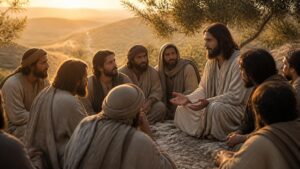
This heavenly mindset is perfectly illustrated—and its values starkly reversed—in the Gospel. Luke’s account of the Beatitudes presents us with the great paradox of the Kingdom of God. Jesus looks at His disciples and declares blessed those whom the world considers cursed: the poor, the hungry, the weeping, and the persecuted. Their blessing lies not in their suffering, but in the fact that God is especially close to them, and their reward will be great in heaven. Conversely, He pronounces woes upon those the world typically envies: the rich, the filled, the laughing, and the praised. The woe is a warning that those who find their ultimate satisfaction and consolation in the things of this world alone are building their lives on a foundation that will not last.
Pope Francis often speaks of this “revolution of tenderness” that the Beatitudes proclaim. He says, “The Beatitudes are like a Christian’s identity card… they show us the face of the Master, which we are called to reflect in our daily lives.” The comfort and spiritual strength we draw from these readings is this: the path of discipleship, though counterintuitive and often difficult, is the path to true and lasting joy. We are not aimlessly wandering; we are seeking what is above. We are not foolish for embracing poverty of spirit, meekness, and mercy; we are investing in eternal riches.
So how do we apply this in our daily lives?
- Start with your gaze. Each morning, consciously “set your hearts on things above.” Begin your day with prayer, offering your work, joys, and struggles to God, asking for the grace to see your day through His eyes.
- Put something to death. Identify one “earthly” habit—a judgmental thought, a attachment to gossip, a tendency toward complaint—and deliberately choose against it. Replace it with an act of charity or a word of thanks.
- Embrace a holy paradox. This week, consciously choose the “blessed” path in one situation. Choose to be generous when you could be greedy. Choose to show mercy when you could hold a grudge. Choose to be meek and listen when you could dominate the conversation.
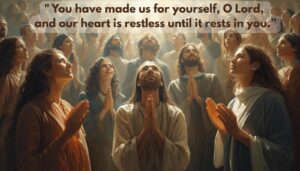
As St. Augustine reminds us, “You have made us for yourself, O Lord, and our heart is restless until it rests in you.” Let us, then, cease our restless seeking for earthly consolations and set our hearts on our true home, where Christ awaits, and where our true treasure lies. Amen.