Friday of the Twenty-fourth Week in Ordinary Time, September 19, 2025
The Pursuit That Truly Enriches
1Tim 6:2c-12, Psalm: 48, Lk 8:1-3
Dear Sisters and Brothers in Christ, in a world that constantly urges us to seek more—more wealth, more status, more security—the Word of God today presents us with a radical alternative: the pursuit of holiness as the only path to true and lasting riches.
Saint Paul, in his letter to Timothy, issues a sobering and urgent warning. He speaks of those who imagine “religion as a means of gain.” This is a timeless temptation: to use our faith to advance our own status, to seek comfort rather than conversion, or to expect earthly rewards for pious practices. But Paul cuts through this illusion with stunning clarity: “Of course, there is great gain in religion, provided one is content with what one has.” True gain, he teaches, is not found in amassing possessions but in possessing Christ. He then delivers one of the most famous lines in all of Scripture: “For the love of money is the root of all evils.” This craving, this endless pursuit, leads only to ruin and separation from God. In its place, Paul exhorts us to a different pursuit: “Pursue righteousness, devotion, faith, love, patience, and gentleness. Compete well for the faith.” This is the race worth running.
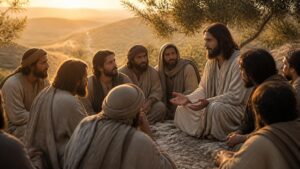
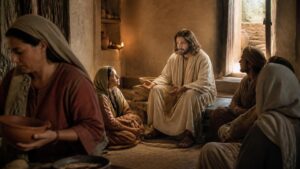
This portrait of true devotion is beautifully illustrated in the Gospel of Luke. We are given a glimpse of Jesus’ traveling ministry, and significantly, we are introduced to the women who supported Him. These women—including Mary Magdalene, Joanna, and Susanna—were not passive observers. They were active disciples who, having been “cured of evil spirits and infirmities,” responded with profound gratitude. Their response was not merely verbal; it was practical, sacrificial, and financial. They provided for Jesus and the Twelve “out of their resources.” They understood that the one who had freed them from spiritual poverty was worthy of their material wealth. Their use of money was not a root of evil, but a root of evangelization, enabling the proclamation of the Kingdom.
These two readings together form a complete picture. Paul warns us against the love of money, which becomes a false god. The Gospel women show us the right use of money, which becomes an instrument of love and service. Their treasure was not in their bank accounts, but in the Kingdom they were helping to build. They were, as Saint John Chrysostom preached, “not storing their wealth in the house of the wealthy, but in the treasure houses of heaven.”
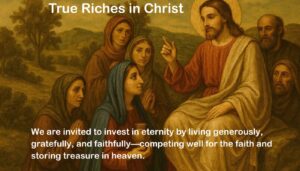
This World offers us immense comfort and strength. We are reassured that God does not demand poverty for its own sake, but rather freedom from enslavement to wealth. He invites us to find our ultimate contentment not in what we have, but in who we have: Christ Jesus. This freedom allows us to use our resources—whether great or small—with generosity and joy, knowing that every gift given in His name is an investment in eternity.
How do we apply this today? We are called to a daily examination of our pursuits. What are we truly striving for? Does our financial planning reflect a trust in God’s providence or a reliance on our own savings? Does the way we spend our money and time support the work of the Gospel?
Let us ask for the intercession of the holy women disciples. May we, like them, be so grateful for the mercy we have received that we are compelled to support the Church’s mission generously. Let us “compete well for the faith,” pursuing the only wealth that death cannot destroy: a life rich in God. Amen.