
Twenty-eighth Sunday in Ordinary Time (C), October 12, 2025
The Grace of Gratitude: The Door to Deeper Faith
2Kgs 5:14-17, Psalm: 97, 2Tim 2:8-13, Lk 17:11-19
My dear Sisters and Brothers in Christ,
In the spiritual life, God’s healing grace often comes to us as a free gift, an unmerited act of divine mercy. But the Scriptures today reveal that our response to that grace is not a mere formality; it is the very door that leads to a deeper, saving relationship with God. Through three powerful encounters, the Holy Spirit teaches us that the journey from healing to salvation is completed by a grateful and faithful heart.
I. The Healing of Naaman: The Humility of Gratitude (2 Kings 5:14-17)
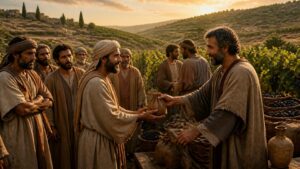
We begin with Naaman, the proud Syrian army commander. He is healed of his leprosy not by dramatic gestures, but by the humble act of obeying the prophet Elisha’s simple command to wash seven times in the Jordan. His healing is physical, but the transformation that follows is spiritual. His flesh becomes “like the flesh of a little child,” symbolizing a new birth. But the story doesn’t end with the cure.
Naaman returns to Elisha, standing before him a changed man. He declares, “Now I know that there is no God in all the earth, except in Israel.” This is a profound act of faith. His gratitude compels him to acknowledge the God of Israel as the one true God. He then tries to offer a gift, which Elisha refuses, emphasizing that salvation is God’s free gift. Finally, Naaman makes a humble request: two mule-loads of earth. Why? Because he believed a deity was territorially bound, he wanted to worship the God of Israel, even on foreign soil, by standing on Israel’s soil. While his theology was imperfect, his intention was one of heartfelt, grateful devotion. His gratitude was the catalyst for a fledgling but sincere faith.
II. The Ten Lepers: The Tragedy of Forgotten Grace (Luke 17:11-19)
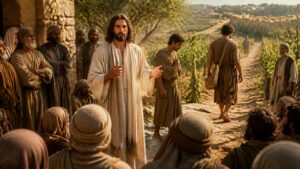
This theme finds its ultimate expression in the Gospel. Ten lepers, social and religious outcasts, cry out to Jesus for mercy. He heals them with a simple command: “Go show yourselves to the priests.” As they go, they are cleansed. Yet, only one, a Samaritan—a double outsider—turns back. He glorifies God in a loud voice, falls at the feet of Jesus, and thanks Him.
Jesus’ response is poignant and revealing: “Ten were cleansed, were they not? Where are the other nine? Has none but this foreigner returned to give thanks to God?” Then He speaks the pivotal words: “Stand up and go; your faith has saved you.” Notice the distinction. All ten were cleansed. But only the one who returned in gratitude was saved. His grateful faith opened the door to a salvation that was more than skin-deep. The nine received the gift but forgot the Giver. They got what they wanted—physical healing—but missed what they truly needed: a saving relationship with the Healer. The tragedy of the nine is the tragedy of a grace received and forgotten.
III. The Endurance of Faith: Gratitude in Suffering (2 Timothy 2:8-13)
But what about when the healing doesn’t come? What about when we are called to endure suffering? St. Paul, writing from prison, completes the picture. He is not experiencing physical liberation but chains. Yet, his heart is filled with a gratitude that transcends circumstances. He urges Timothy to “remember Jesus Christ, raised from the dead, a descendant of David.” This is the heart of our faith: the crucified and risen Christ.
Paul shares a beautiful early Christian hymn: “If we have died with him, we shall also live with him; if we persevere, we shall also reign with him.” This is the faith of the grateful leper, applied to the cross. It is the conviction that even in suffering, God is at work for our salvation. This allows us to be grateful not for the suffering, but in the midst of it, trusting in God’s ultimate fidelity. As Pope St. John Paul II often said, suffering is a sharing in Christ’s redemptive work. Our faithful endurance, rooted in gratitude for the Paschal Mystery, becomes a source of salvation for ourselves and others.
The Eucharist – Our Thanksgiving
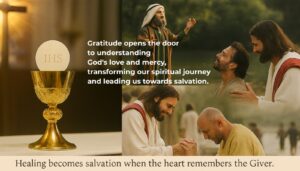
My dear Sisters and Brothers in Christ, the common thread is clear: gratitude is not an optional add-on to faith; it is the engine of salvation. The one leper shows us that gratitude draws us back to Christ, and in that return, we find not just healing, but wholeness.
This is why the central act of our worship is called the Eucharist, which means “Thanksgiving.” At this altar, we are like Naaman and the Samaritan leper. We come with our needs, our spiritual leprosy. God offers us the ultimate healing gift: the Body and Blood of His Son. But the Mass does not end with the reception of Communion. It ends with the sending forth: “Go forth, the Mass is ended.” This is our call to “return to give thanks,” to live a Eucharistic life, a life of gratitude that manifests itself in praise, in service, and in faithful endurance.
Let us ask for the grace to be the one who returns. May we never be counted among the nine who receive God’s gifts and go on their way, but among the grateful few whose faith, born of thanksgiving, leads to salvation. Amen.