
Friday of the Twenty-eighth Week in Ordinary Time, October 17, 2025
The Faith That Frees Us from Fear
Rom 4:1-8, Psalm: 31, Lk 12:1-7
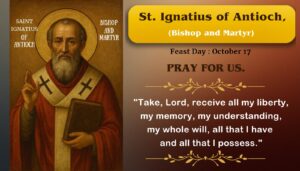
Memorial of Saint Ignatius of Antioch, Bishop and Martyr
My dear Sisters and Brothers in Christ,
On this Memorial of the great Saint Ignatius of Antioch, a bishop who was martyred for his faith in the Roman arena, the Word of God speaks directly to the deepest anxieties of the human heart. It addresses the fear of judgment and the fear of man, offering in their place the liberating gifts of faith and filial trust.
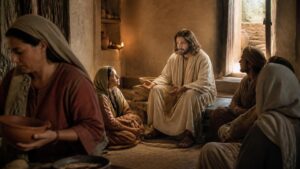
In the Gospel, Jesus speaks to His disciples in the midst of a crowd of thousands. He warns them, first and foremost, to “beware of the leaven of the Pharisees, which is hypocrisy.” The hypocrisy He condemned was a faith of external performance, driven by a fear of human opinion. It was a life lived for the approval of others, which He said is ultimately worthless because “nothing is concealed that will not be revealed.” But then, Jesus immediately pivots from this warning about human judgment to a reassurance about divine judgment. “Do not be afraid of those who kill the body,” He says, “but after that can do no more.” The one we are to hold in awe is God, who holds our eternal destiny in His hands. And yet, this awe is not the terror of a slave before a cruel master, but the reverence of a child for a loving Father. To prove this, Jesus points to the sparrows, sold cheaply in the market, and the hairs of our head, noting that not one is forgotten by God. “You are worth more than many sparrows,” He assures us. Our value is not determined by human opinion, but by God’s intimate, providential care.
This perfect love, which casts out fear, is rooted in the reality Saint Paul explains in our first reading. He takes us back to Abraham, the father of all believers. How was Abraham justified? Was it by his works, by his external observance of the law? No, Paul insists. “Abraham believed God, and it was credited to him as righteousness.” Justification is a gift received through faith, not a wage earned by works. Paul reinforces this with the words of King David, who proclaims the blessedness of the person “whose sin the Lord does not record.” Our standing before God is not based on a flawless spiritual resume, but on His merciful forgiveness, which we receive through faith.
This is the truth that sets us free from fear. If we are right with God not by our own shaky perfection but by His gracious gift, then we have nothing to fear from human judgment. We are liberated from the “leaven of the Pharisees”—the need to appear holy—because we are secure in the holiness God gives us in Christ.
This is the faith that fueled Saint Ignatius of Antioch. As he was marched to Rome to be devoured by beasts, he did not fear those who could only kill his body. He wrote magnificent letters overflowing with a desire for union with Christ, declaring, “I am God’s wheat, and I shall be ground by the teeth of beasts, that I may become the pure bread of Christ.” He was not afraid, because his righteousness was not his own; it was Christ’s. His value was not in his earthly life, but in his eternal destiny.
For us, the application is clear. We are called to live with the same freedom. When we are tempted to fear the gossip, the criticism, or the disapproval of others, we must remember our true worth in God’s eyes. When we are anxious about our failures and sins, we must run to the God who justifies the wicked through faith, not the God who rewards the perfect.
As Pope Francis often says, “God’s love is not generic; it is concrete.” He knows each of us intimately and loves us personally. Let us ask for the intercession of Saint Ignatius today. May his courageous faith inspire us to let go of hypocrisy and human fear, and to rest in the joyful, freeing truth that we are known, loved, and saved by a merciful Father. Amen.