Monday of the Twenty-ninth Week in Ordinary Time, October 20, 2025
True Riches: The Faith That Makes Us Rich Toward God
Rom 4:20-25, Psalm: Lk 1, Lk 12:13-21
My dear Sisters and Brothers in Christ,
In a world that constantly measures success by what we own and what we have stored up for ourselves, the Word of God today poses a fundamental question: What is the true foundation of our security? What constitutes real wealth? Through the inspiring example of Abraham and the sobering parable of the rich fool, the Holy Spirit calls us to a radical re-evaluation of our treasures.
St. Paul holds up Abraham as the model of faith. He writes, “Abraham did not doubt God’s promise in unbelief; rather, he was empowered by faith and gave glory to God, fully convinced that what God had promised he was also able to do.” Abraham’s wealth was not in flocks or land, but in his unwavering trust in God’s word, even when that word seemed humanly impossible. His security was not in a five-year plan, but in a divine promise. Paul explains that this faith, this radical reliance on God, “was credited to him as righteousness.” This is the true wealth that matters in eternity—a right relationship with God, achieved not by our works, but by our faith in the God “who raised Jesus our Lord from the dead.”
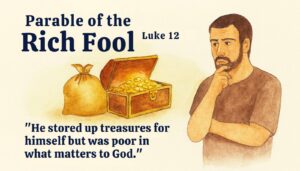
This portrait of faith stands in the starkest contrast to the man in the Gospel parable. When asked to settle a family dispute over an inheritance, Jesus refuses to be an arbiter of worldly wealth. Instead, He tells a story of a rich man whose land produces a bumper crop. His problem is not his success, but his response. He has a “me-focused” conversation with his own soul: “What shall I do? I have no place to store my crops… I will tear down my barns and build bigger ones.” His entire plan is to “rest, eat, drink, be merry!” He believes his security lies in his abundant possessions. But God calls him a “fool,” because his life is demanded of him that very night. Jesus concludes, “Thus will it be for the one who stores up treasure for himself but is not rich in what matters to God.”
The rich fool’s sin was not his wealth, but his practical atheism. He lived as if God did not exist. He thanked his own hard work, not God’s providence. He planned for his body, but neglected his soul. His barns were full, but his heart was empty of love for God and neighbor.
So, what does it mean for us to be “rich in what matters to God”? It means to have the faith of Abraham. It means to build our security not on the shifting sands of financial portfolios or material possessions, but on the rock of God’s promises. It means to be “fully convinced” that God will provide for our truest needs.
This does not mean we should be irresponsible. But it does mean we must constantly check our hearts. Where do we place our ultimate trust? When we are anxious about money, do we cling tighter to our savings, or do we turn to God in prayer? Do we see our material goods as solely for our own comfort, or as gifts from God to be shared for the building of His kingdom?
Pope Francis often warns against the “idolatry of money,” which leads to a culture of indifference. St. John Paul II taught about the “law of gift”—that we find ourselves not through possessing, but through giving.
The comfort today is that God desires to make us truly rich. He invites us to transfer our trust from our barns, which can rot and be stolen, to His eternal love, which never fails. Let us ask for the grace to imitate Abraham’s faith, to be “fully convinced” of God’s power and love, so that when our own life is demanded of us, we will be found rich in the only treasure that endures: a faith that has been credited to us as righteousness. Amen.