
Monday of the Thirty-first Week in Ordinary Time, November 3, 2025
The Economy of Grace
Voice over by Esther Han
Rom 11:29-36; Psalm: 68; Lk 14:12-14
Dear Sisters and Brothers in Christ, the Word of God today invites us into a radical reorientation of our hearts, challenging us to exchange the world’s economy of reciprocal exchange for the divine economy of grace. In this realm, love is given freely, not for reward, but in imitation of our generous God.
Saint Paul, in his letter to the Romans, concludes a profound reflection on God’s plan of salvation with a burst of praise. He declares a foundational truth: “The gifts and the call of God are irrevocable.” God’s grace is not a loan that can be recalled or a contract that can be voided. It is a free, permanent, and unmerited gift. We were once disobedient, yet we have now received mercy. This reality leads Paul to a stunning doxology: “For from him and through him and for him are all things.” Our very existence is a gift. Our salvation is a gift. Everything we have is received from the boundless depths of God’s wisdom and knowledge, whose judgments are “inscrutable” and whose paths are “unsearchable.” We stand not as entitled claimants, but as grateful recipients.
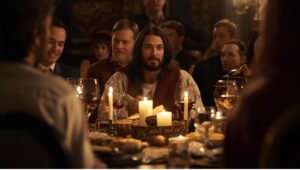
It is from this posture of profound gratitude that the teaching of the Gospel makes perfect sense. Jesus, attending a banquet, observes the worldly logic of inviting friends, relatives, and rich neighbors who can return the favor. This is the closed loop of human transaction. But Jesus shatters this loop. He says, “When you hold a banquet, invite the poor, the crippled, the lame, the blind; blessed indeed will you be because of their inability to repay you.” Why? Because this act of disinterested charity mirrors the very heart of God. You will be repaid, not at a later date by the recipient, but “at the resurrection of the righteous” by the Father Himself.
Our worship of the inscrutable, generous God (Romans) must express itself in a life of inscrutable, generous love (Luke). We are called to give, not because we will get something back from the person we give to, but because we have already received everything from God. Our charity becomes a living doxology, a practical echo of Paul’s hymn of praise.
This is where we find both comfort and strength. The comfort is that our standing before God is secure in His irrevocable call; we do not have to earn His love. The strength is the grace to go then and love others without the burden of expecting a return. As Saint John Chrysostom preached, “When you see a poor believer, remember that you are looking at the altar of God.” The person who cannot repay you is the very channel through which you can offer pure worship to the Father.
How do we apply this in our daily lives? We are called to examine our acts of giving. Do we only help those we like, or those who might advance our social standing? Do we donate quietly, or only when there is public recognition? The Lord invites us to a purer intention: to invite the lonely coworker for coffee, to serve at a soup kitchen without posting about it, to donate to a cause anonymously.
Let us ask for the grace to live in the divine economy. May our lives become a continuous act of thanksgiving for God’s unsearchable mercy, expressed in a charity that is as free and irrevocable as the love we have first received. For in the end, as we learn to give without expectation of return, we discover we were never owners, but always stewards of God’s boundless gifts. Amen.
May the souls of the faithful departed, through the mercy of God, rest in peace. Amen.