
Christmas Message of His Eminence Cardinal Charles Bo on December 23, 2025
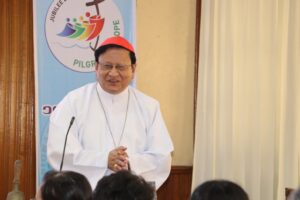
“Peace be with you all.”
Dear beloved
Your Excellency, Senior General Min Aung Hlaing,
All responsible personnel of the nation,
Msgr. Andrea Ferrante, Papal Representative to Myanmar,
The beloved pastors of the Myanmar Council of Churches,
All who have gathered in prayer,
Brothers and sisters,
“Peace be with you” is a greeting shared by people of every nation and faith for thousands of years.
The Almighty God was born as a Child. From the moment He was conceived in His mother’s womb and laid in a manger in Bethlehem, through His incarnation and finally His acceptance of death on the Cross, His life was marked by humility. At His birth, the angels proclaimed: “Peace on earth.” God chose to enter human history as a fragile child—without power, without protection, without worldly attraction.
Yet a child can enter our hearts. A child has the power to change us. The Child Jesus reminds us of our own fragility and limitations. For this reason, God hid His glory and took human form to teach us how to live in peace.
Before His arrest, Jesus strengthened His disciples, saying:
“Peace I leave with you; my peace I give to you. I do not give to you as the world gives. Do not let your hearts be troubled, and do not be afraid.” (John 14:27)
The disciples struggled to accept Jesus’ path of peace without revenge. They knew there were those who sought to kill Him. Still, Jesus preached peace. When His enemies came to arrest Him, and a disciple drew his sword, Jesus said:
“Put your sword back into its sheath.” (John 18:11)
The peace of the Risen Christ is peace without weapons. In His time, Jesus brought political and social transformation without violence. Christians are called to witness this noble way and to invite all to reject cruelty. True peace heals wounds through compassion and care for the least among us.
Everyone loves peace and longs for it. Yet in a world of growing uncertainty, fear increases. Not only individuals, but entire nations feel unsafe. Peace seems distant. People prepare for war in the name of peace. Governments are accused of weakness if they do not respond to violence with violence. As a result, nearly every nation continues to accumulate weapons.
In 2024 alone, global military spending reached 2.718 trillion US dollars. This arms buildup is treated as an unavoidable responsibility. The root of this crisis lies in relationships between nations that are built not on law, justice, and trust, but on fear and domination. Consequently, people live in constant anxiety, believing that war could erupt at any moment.
As long as fear dominates, weapons will continue to multiply. Today, instead of stockpiling arms, nations must choose mutual respect and cooperation as the path to lasting peace.
For this reason, the Pope calls for the complete abolition of weapons. But this call goes deeper: we are also invited to disarm the weapons within our own hearts. Peace is not merely a destination—it is a journey and a way of life. Peace must first take root in our hearts. When we allow peace to dwell within us, we can share its warmth with others.
Saint Augustine reminds us:
“If you wish to draw others to peace, first have it yourselves. To inflame others, you must have the flame burning within you.”
Religion also has a crucial role in peacebuilding. Across the world, political conflict, ethnic division, and terrorism sometimes misuse religion. All of us share the responsibility to prevent the abuse of God’s name. Prayer, spiritual practice, and interreligious dialogue are noble and essential paths to peace.
Every religious community is called to build peaceful homes through dialogue, justice, and forgiveness—never through hatred.
Blessed are the peacemakers. God bless all those who strive for peace in Myanmar through every possible means. We pray that 2026 may be a year of peace for Myanmar and for the whole world.
Though hope is shaken by war, terrorism, and inequality, peace remains an undeniable need of humanity. Hatred and violence arise from human weakness, but forgiveness and mercy are the strengths that rebuild humanity.
Dialogue, listening, and patience with one another’s weaknesses are bridges across our differences.
Let the voices of the weak, the poor, and the refugees be heard.
Let peace be shown not only in words, but proven through actions.
O God of all goodness,
Your peace surpasses the confusion of the world.
Make us apostles of peace,
bearers of love and hope for all humanity.
Trusting in Your love and compassion,
we offer this prayer with full hearts.
Amen.