Friday of the First Week in Ordinary Time, January 16, 2026
The Authority That Truly Heals
Voice over by Carol San San Lwin
1Sam 8:4-7.10-22a, Psalm: 88, Mk 2:1-12
My dear Sisters and Brothers in Christ,
In every age, the human heart seeks an authority to follow, a power to trust in. We look for security in systems, in leaders, in the visible structures of the world. But today’s Scriptures present us with a vital choice: between an authority that takes and controls, and an authority that gives and heals. It is the choice between the kings of this world and the King of Heaven.
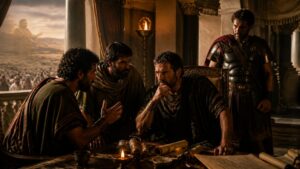
In the First Book of Samuel, we witness a spiritual crisis. The people of Israel approach the prophet Samuel with a demand: “Appoint a king over us, as other nations have.” They are rejecting God’s unique, intimate kingship over them in favor of a visible, human monarch. God says to Samuel, “It is not you they reject, they are rejecting me as their king.” Despite Samuel’s solemn warning—that a king will take their sons for war, their daughters for service, their best fields and crops—the people refuse to listen. “We too must be like other nations,” they insist. They choose the authority of the sword and the crown over the quiet, demanding authority of the Lord. This is the perennial temptation: to prefer a power we can see and control, even if it enslaves us, over the God whose authority requires faith and trust.
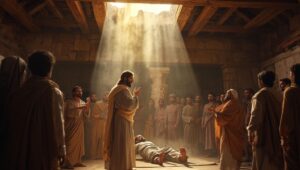
This makes the scene in the Gospel of Mark so revolutionary. Here, a different kind of authority is on full display. A paralyzed man is brought to Jesus by friends so faithful they tear open a roof to lower him down. Jesus, seeing their faith, says to the paralytic, “Child, your sins are forgiven.” The scribes are horrified, reasoning correctly that only God can forgive sins. Jesus, knowing their thoughts, poses a question that reveals everything: “Which is easier, to say to the paralytic, ‘Your sins are forgiven,’ or to say, ‘Rise, pick up your mat and walk’?” To prove that the Son of Man has “authority on earth to forgive sins,” He tells the man, “Rise, pick up your mat, and go home.” The man is healed instantly, body and soul.
Here is the authority of God made flesh. It does not take, but gives. It does not enslave, but liberates. It heals the deepest paralysis of the soul before addressing the body. This is the kingship Israel rejected and the world still overlooks: an authority rooted in merciful love, exercised for our restoration.
For us, the challenge is clear. Where do we place our trust? In the “kings” and systems of this world that promise security but often demand our souls? Or in the compassionate authority of Christ, who forgives our sins and commands us to walk in newness of life?
Like the Israelites, we can be tempted by visible power. But the Gospel calls us to the faith of the paralytic’s friends—a faith that persistently brings our brokenness and the brokenness of others to Jesus, trusting in His authority to heal what we cannot.
We will only find peace under the gentle yoke of Christ’s authority. Pope Francis echoes this, urging us to trust in God’s mercy, which is His “masterpiece of authority.”
Let us, then, reject the clamor for worldly power. Let us instead daily approach the Lord with the humility of the paralytic and the boldness of his friends, confident in the one Authority who says to us, “Your sins are forgiven. Rise, and walk.” Amen.
May God bless you all!