Monday of the Third Week in Ordinary Time, January 26, 2026
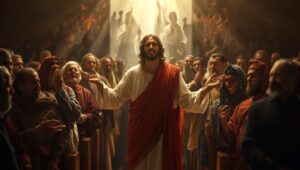
Building Up, Not Tearing Down
Voice over by Angeline Chue Chue
2Sam 5:1-7.10, Psalm: 88, Mk 3:22-30
Memorial of Saints Timothy and Titus, Bishops
My dear Sisters and Brothers in Christ,
On this Memorial of Saints Timothy and Titus, two faithful companions of Saint Paul who helped build up the early Church, the Word of God presents us with a stark contrast between two kinds of power: one that unites and builds up, and another that divides and tears down. Through the anointing of a king and the defense of the true King, we are called to be instruments of unity in a world too often marked by suspicion and strife.
In the Second Book of Samuel, we witness a pivotal moment of unity. All the tribes of Israel come to David at Hebron and declare, “Here we are, your bone and your flesh.” They recognize that even when Saul was king, it was David who led them. They anoint him king over all Israel. David then conquers Jerusalem, the stronghold of Zion, which becomes the “City of David.” The crucial line follows: “David grew steadily more powerful, for the Lord of hosts was with him.” David’s power and success are directly attributed to God’s presence. His kingship, despite its flaws, becomes a sign of God’s desire to gather and unite His people under His protection.
This divinely-established unity stands in contrast to the scene in the Gospel. The scribes from Jerusalem, witnessing Jesus’ power over demons, level a devastating accusation: “He is possessed by Beelzebul,” and “By the prince of demons he drives out demons.” They witness God’s power at work—the same power that was with David—but they attribute it to evil. Jesus responds with unassailable logic: “How can Satan drive out Satan? If a kingdom is divided against itself, that kingdom cannot stand.” He identifies their accusation as blasphemy against the Holy Spirit, the sin of calling good evil, of calling God’s work the devil’s work. This is the ultimate act of division—to look upon healing and unity and see only a threat.
Saints Timothy and Titus, whose memory we celebrate, were disciples in the mold of the unity-builders, not the dividers. Paul left them in charge of the fractious communities of Ephesus and Crete not to lord it over them, but to “build up,” to “correct with all authority,” and to appoint elders of good character (Titus 1:5). Their task was to preserve the unity of the Spirit in the bond of peace, combating false teachings that divided the flock.
For us, the message is clear. We are called to be Davids, Timothys, and Tituses—builders of unity under Christ the true King. We must examine our own words and attitudes. Do we, like the scribes, hastily attribute bad motives to others, especially within the household of faith? Do we spread suspicion, or do we seek to understand and reconcile?
In a Church and a world often polarized, our Christian witness is one of communion. As Pope Francis constantly reminds us, “Unity is greater than conflict.” It is a fruit of the Holy Spirit, whom we must never blaspheme by calling division holy.
Let us pray for the intercession of Saints Timothy and Titus. May they obtain for us the grace to use our tongues to build up, and our hearts to discern God’s unifying work in our midst, so that we may be true citizens of the City of God, which is forever united in love. Amen.
May God bless you all!