Fourth Sunday in Ordinary Time (A), February 1, 2026
The Blessed Revolution: God’s Upside-Down Kingdom
Voice over by Carol San San Lwin
Zeph 2:3; 3:12-13, Psalm: 145, 1Cor 1:26-31, Mt 5:1-12
My dear Sisters and Brothers in Christ,
If we were to write a recipe for happiness, for a successful and blessed life, what ingredients would we include? Security, strength, comfort, influence, and perhaps a good reputation. Yet today, the Word of God presents us with a recipe that seems, by every worldly standard, to be not just counterintuitive, but completely upside-down. Through the prophet, the apostle, and the Lord Himself, we are invited into the blessed revolution of God’s Kingdom, where true strength is found in surrender, and glory is discovered in humility.
The prophet Zephaniah sets the stage with a call that defies human logic. He summons “all you humble of the earth” to “seek the Lord… seek justice, seek humility.” The remnant that will be saved is not the powerful, but a “people humble and lowly.” They will take refuge in the Lord, do no wrong, speak no lies, and “they shall pasture and couch their flocks with none to disturb them.” This is a portrait of blessedness rooted not in conquest, but in trust; not in arrogance, but in quiet dependence on God.
Saint Paul takes up this theme with stunning clarity in his letter to the Corinthians. Looking at the community, he notes, “Not many of you were wise by human standards, not many were powerful, not many were of noble birth.” Yet, God chose them. Why? “So that no human being might boast before God.” The divine strategy is to reveal that true wisdom, righteousness, sanctification, and redemption come from God alone, in Christ Jesus. Therefore, Paul concludes, “Whoever boasts, should boast in the Lord.” Our glory is never our own achievement; it is always a reflection of His grace at work in our weakness.
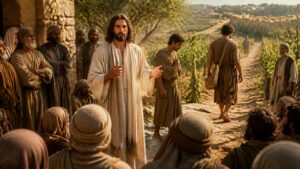
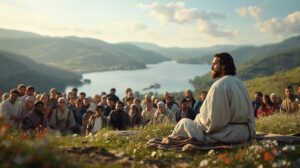
This supreme revelation of God’s upside-down kingdom reaches its zenith in the Gospel, as Jesus ascends the mountain and delivers the Beatitudes. He looks out at the poor, the mourning, the meek, the persecuted, and He declares them blessed. This is not a sentimental consolation for a miserable lot in life. It is a radical proclamation of a new reality. The Kingdom of Heaven belongs to the “poor in spirit”—those who know their utter need for God. The mourners will be comforted by the God of all consolation. The meek—the gentle, the non-violent, the unassuming—will inherit the earth. Those who hunger for righteousness will be filled.
Jesus is describing the character of those who have embraced the reality Paul and Zephaniah announced. They are blessed not because they suffer, but because in their poverty, mourning, and meekness, they are radically open to receiving God as their only treasure, comfort, and strength. They live by a different logic: the logic of divine generosity, which satisfies the hungry heart that the world cannot fill.
This blessed revolution is the very path of the saints. St. Thérèse of Lisieux, a Doctor of the Church, lived the Beatitudes in her “little way” of spiritual childhood—embracing her smallness and weakness so that God could be her everything. St. Mother Teresa saw the face of Christ in the poorest of the poor, hungering for righteousness and offering comfort to those who mourned. They understood that the Beatitudes are a portrait of Christ Himself, and by living them, we are configured to Him.
So, what does this mean for us? We are called to a profound examination of our own hearts and our definition of success. Where are we seeking the world’s approval instead of God’s blessing? Are we afraid of appearing weak, of being gentle, of mourning with those who suffer, of hungering for a holiness that sets us apart?
The comfort today is immense. You are invited into this blessedness. If you feel poor in spirit—inadequate, weak, or aware of your sin—you are on the threshold of the Kingdom. If you mourn a loss or an injustice, the Divine Comforter draws near. If you strive for purity of heart or to make peace, you are a child of God.
Let us ask for the grace to embrace this holy paradox. Let us seek the humility Zephaniah proclaims, boast only in the Lord as Paul teaches, and strive to live the Beatitudes that Jesus commands. For in this upside-down kingdom, we will find the only happiness that lasts, and become true lights of Christ’s revolutionary love to the world. Amen.
May God bless you all!