Tuesday of the Fourth Week in Ordinary Time, February 3, 2026
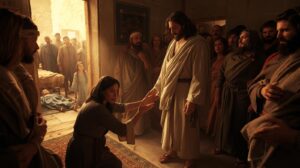
The Touch of Faith in a World of Power
Voice over by Carol San San Lwin
2Sam 8:9-10.14b.24-25a.30—19:3, Psalm: 85, Mk 5:21-43
My dear Sisters and Brothers in Christ,
Our world often tells us that strength is found in control, in influence, and in never showing weakness. Yet today, Scripture reveals a profound truth: God’s power is most clearly manifested not in the halls of human authority, but in the moments of our greatest vulnerability and surrender. Through a tale of political collapse and two stories of desperate hope, we learn that the Kingdom of God operates on an entirely different principle.
In the First Book of Samuel, we witness the tragic unraveling of King David’s household through the rebellion of his son, Absalom. It is a story of raw political power, betrayal, and violence. Absalom’s bid for the throne ends in his death, leaving David to weep not for his kingdom, but for his child: “My son Absalom! If only I had died instead of you!” Even with all his royal power, David is powerless to stop the consequences of sin or to heal the deep wounds within his own family. Human power, it seems, has severe limits.
This makes the events in the Gospel of Mark all the more startling. We see two individuals who have reached the end of their own resources. Jairus, a synagogue official—a man of some standing—falls at Jesus’ feet because his daughter is dying. His status cannot save her. On the way, a woman who has suffered hemorrhages for twelve years, left destitute and ritually unclean by doctors, reaches out in a crowd simply to touch Jesus’ cloak. “If I but touch his clothes,” she thinks, “I shall be cured.”
Both represent absolute human vulnerability. One’s social power is useless; the other has no social power left. Their only common asset is a desperate, persistent faith. Jesus responds to this faith. To the woman, He says, “Daughter, your faith has saved you. Go in peace.” To Jairus, after news of his daughter’s death, He says, “Do not be afraid; just have faith.” In both cases, the touch of faith—whether a hand reaching out or a plea falling at His feet—releases a divine power that human authority could never muster.
The contrast is stark. Absalom’s grasp for power leads to death. The humble touch of faith leads to life and peace. This is the economy of God’s Kingdom.
For us, the message is both a comfort and a challenge. Where are we relying on our own “power”—our competence, our reputation, our ability to control—and coming up empty, like David weeping for his son? And where are we, like Jairus and the suffering woman, being called to surrender our vulnerability to Christ in raw faith?
Perhaps it’s in a financial worry we can’t fix, a family rift we can’t heal, or a personal struggle we can’t overcome. The Lord invites us today to do what feels counterintuitive: to stop strategizing and simply reach out. To touch Him in prayer with the honesty of our need. As St. Thérèse of Lisieux taught, “The weaker one is, without desires or virtues, the more suited one is for the workings of this consuming and transforming love.”
Let go of the pretense of control. Bring your helplessness to Him. For it is at the point of our greatest powerlessness that His power is perfected, and He says to us, “Your faith has saved you. Go in peace.” Amen.
May God bless you all!