Tuesday of the Sixth Week in Ordinary Time, February 17, 2026

The Bread of Trust: Remembering God’s Faithfulness
Voice over by Eliz
Jas 1:12-18, Psalm: 93, Mk 8:14-21
My dear Sisters and Brothers in Christ,
How easily we fall into spiritual amnesia. In the face of a new worry, a fresh anxiety, we can forget every past instance of God’s provision, as if He has never cared for us before. Today’s readings offer us a powerful remedy: a call to remember God’s perfect faithfulness, and to recognize that every good thing we need—and truly desire—flows from His unchanging fatherly heart.
Saint James begins with a blessing for those who persevere under trial: they will receive “the crown of life that the Lord has promised to those who love him.” Then he offers a crucial clarification about the source of our trials: “No one experiencing temptation should say, ‘I am being tempted by God.’” God is not the author of our temptation. Instead, James describes a process: we are lured and enticed by our own desire, which gives birth to sin, which when fully grown brings forth death. In contrast, he proclaims, “Every good gift and every perfect gift is from above, coming down from the Father of lights, with whom there is no alteration or shadow caused by change.” Our hope, therefore, is not in our own wavering strength, but in the unwavering goodness of the Father who gives us the perfect gift—the “word of truth” by which we are reborn.
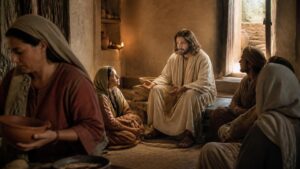
This failure to trust in the Father’s good gifts is exactly what Jesus confronts in the Gospel. The disciples are in a boat, and they have forgotten to bring bread. They have one loaf. Jesus, aware of their practical worry, uses it as a teaching moment. “Watch out, guard against the leaven of the Pharisees and the leaven of Herod.” The disciples misunderstand, thinking He’s scolding them about the bread. And then, in a series of poignant questions, Jesus jolts their memory: “Do you not yet understand or comprehend? Are your hearts hardened? Do you have eyes and not see, ears and not hear? And do you not remember, when I broke the five loaves for the five thousand… or the seven loaves for the four thousand?” He concludes, “Do you still not understand?”
Their worry about physical bread reveals a deeper amnesia. They have forgotten the miraculous provision they themselves witnessed. They have forgotten the character of the one in the boat with them. The “leaven” of the Pharisees and Herod is the leaven of distrust—of seeking signs, of relying on human power and political calculation instead of on the Father of lights.
For us, the application is direct and comforting. When anxiety rises—about money, health, the future—we must consciously combat the “leaven of distrust.” We do this by doing what the disciples failed to do in that moment: we remember. We recall the “loaves and fishes” in our own lives: the times God provided, healed, opened a door, gave peace.
St. Thérèse of Lisieux, who faced great spiritual darkness, wrote, “When I am in darkness, when I feel nothing, that is the moment to put more trust than ever.” Her trust was in the Father of lights, not in her own feelings.
Today, let us examine our hearts. What are we worried about having only “one loaf” of? Time? Resources? Patience? Let us bring that worry to Jesus in the boat. And let us hear His gentle, prodding question: “Do you not remember?” Remember His past faithfulness. Remember His nature as the Giver of every good gift. And from that memory, let a steadfast trust be born—a trust that knows our true bread is His presence, and with Him, we will always have enough. Amen.
May God bless you all!