First Sunday of Lent (A), February 22, 2026
The Great Reversal: From Adam’s Failure to Christ’s Victory
Voice over by Eliz
Gen 2:7-9; 3:1-7, Psalm: 50, Rom 5:12-19, Mt 4:1-11
My dear Sisters and Brothers in Christ,
On this First Sunday of Lent, the Church, in her wisdom, takes us back to the very beginning. She shows us the root of our human struggle, not to discourage us, but to reveal the breathtaking scope of God’s rescue mission. In the garden, a battle was lost. In the desert, that same battle was won. And we, through baptism, are invited to live in the light of that victory.
Our story opens in Genesis, with humanity at the pinnacle of God’s creation. The Lord God forms man from the clay of the earth and breathes into his nostrils the breath of life. He places him in a garden of delight, giving him every good thing, with only one loving boundary: “You are free to eat from any of the trees of the garden except the tree of knowledge of good and evil.” Enter the serpent, the embodiment of deceit. He does not deny God’s power; he questions God’s goodness. “Did God really tell you not to eat from any of the trees?” He sows distrust. “You certainly will not die! God knows that when you eat it your eyes will be opened, and you will be like gods.” The temptation is threefold: the lust of the flesh (“good for food”), the lust of the eyes (“pleasing to the eyes”), and the pride of life (“desirable for gaining wisdom”). Adam and Eve choose to define good and evil for themselves. They grasp at divinity and lose their innocence. Their eyes are opened, but to shame, not glory. This is the “Original Sin”: not just an act, but a state of broken trust, fractured relationship, and a wounded nature inclined to sin.
Saint Paul, in his Letter to the Romans, provides the divine commentary. He explains the cosmic consequences of that one man’s disobedience. “Through one man sin entered the world, and through sin, death, and thus death came to all men, inasmuch as all sinned.” Sin and death become the tragic inheritance of humanity. But Paul does not leave us in despair. He immediately proclaims the Great Reversal: “If by that one person’s transgression the many died, how much more did the grace of God and the gracious gift of the one man Jesus Christ overflow for the many!” He sets up the parallel: Adam and Christ. The First Adam brought condemnation; the New Adam brings justification. The disobedience of one brought sin; the obedience of One brings grace.
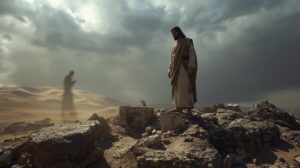
This brings us to the desert in Matthew’s Gospel. Jesus, freshly baptized and proclaimed the beloved Son, is led by the Spirit into the wilderness to be tempted by the devil. The New Adam enters the arena where the first Adam fell. After forty days of fasting, the tempter comes. The three temptations mirror the garden precisely, but where Adam failed, Christ triumphs.
“Command that these stones become loaves of bread.” The lust of the flesh. Jesus, truly hungry, refuses to use His divine power for self-serving comfort. “One does not live on bread alone, but on every word that comes forth from the mouth of God.” He trusts the Father’s provision.
“Throw yourself down…” The pride of life, a demand for a spectacular, self-aggrandizing sign. Jesus rejects testing God: “You shall not put the Lord, your God, to the test.” His identity as Son rests in obedience, not spectacle.
“All these I shall give to you…” The lust of the eyes, the offer of all the kingdoms of the world in exchange for worship. Jesus commands, “Get away, Satan! The Lord, your God, shall you worship and him alone shall you serve.” He refuses the shortcut to glory that bypasses the Cross.
Where the first Adam doubted God’s goodness and grasped, the New Adam trusts the Father’s word and obeys. He reverses the disobedience. As the early Church Fathers proclaimed, “What was bound in Adam is loosed in Christ.”
So what does this mean for us this Lent? We are not mere spectators of an ancient drama. We are participants. In our baptism, we were incorporated into Christ, the New Adam. The victory of the desert is ours to claim. Yet, we still feel the tug of the old Adam within us—the temptations to distrust, to comfort, to control, to pride.
Lent is our forty days in the desert with Jesus. It is our training ground in trust. Our fasting strengthens us to say “no” to the lust of the flesh. Our prayer roots us in the Word of God, our true food. Our almsgiving dethrones the idol of possession and practices the worship of God alone.
St. Augustine said, “The Lord, having made us in his image, made us capable of his unity, but by the sin of one man we lost this capacity. But then there came the one man, Christ, who won the victory.” This Lent, let us walk closely with this Victorious One. Let us bring our temptations to Him. Let us learn from His obedience. For the same Spirit that led Him into the desert and sustained Him in victory is given to us. In Him, our failures are forgiven, our brokenness is healed, and our humanity is restored to the glory for which it was first created. Amen.
May God bless you all!