Pentecost Sunday, May 24, 2026
The Fire That Unites: Pentecost and Our Mission
Voice over by Bro. Paschal
Acts 2:1-11, Psalm: 103, 1Cor 12:3b-7.12-13, Jn 20:19-23
My dear Sisters and Brothers in Christ,
Today, the Easter season reaches its glorious culmination. For fifty days, we have followed the Risen Lord from the empty tomb to the Ascension. Now, we receive the promised gift. The Holy Spirit descends not as a distant memory, but as a living fire. Pentecost is not merely an event in the past; it is the birthday of the Church and the continual source of her life. Today, the same Spirit who rested on the apostles is poured out upon us, empowering us to witness, unifying us as one body, and sending us forth to forgive and to proclaim.
In the Acts of the Apostles, Luke paints a scene of stunning reversal. The disciples are gathered in one place, behind locked doors, still fearful. Then a noise like a strong driving wind fills the house. Tongues as of fire rest on each of them, and they are filled with the Holy Spirit. They begin to speak in different tongues, and the devout Jews from every nation under heaven hear them declaring the mighty acts of God in their own languages. The curse of Babel is reversed. At Babel, human pride fragmented humanity into confusion. At Pentecost, the Spirit gathers the scattered, making one family out of many nations. The Church is born catholic—universal—not by human strategy, but by the breath of God.
Saint Paul, in his first letter to the Corinthians, unpacks the theological meaning of this event. “No one can say, ‘Jesus is Lord,’ except by the Holy Spirit.” Faith itself is a gift of the Spirit. Then Paul emphasizes diversity within unity: “There are different kinds of spiritual gifts but the same Spirit; different forms of service but the same Lord; different workings but the same God who produces all of them in everyone.” The Spirit does not erase our uniqueness; He orchestrates it. Just as the body has many members with different functions, so the Church, “whether Jews or Greeks, slaves or free persons,” is baptized into one body and given one Spirit to drink. Pentecost is not uniformity; it is harmony. The many languages become one proclamation; the many gifts become one mission.
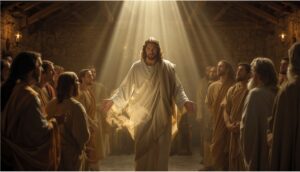
In the Gospel of John, we return to the upper room on the evening of Easter Sunday. The disciples are still afraid, hiding behind locked doors. Jesus comes, stands in their midst, and says, “Peace be with you.” Then He shows them His hands and His side. He breathes on them and says, “Receive the Holy Spirit. Whose sins you forgive are forgiven them; whose sins you retain are retained.” John’s Pentecost is quieter than Luke’s—no wind, no fire—but no less real. The same Spirit who descended at Pentecost is given here through the breath of the Risen Lord. And the first gift of that Spirit is the power to forgive. The mission of the Church is not political power or worldly success; it is the ministry of reconciliation.
These three readings form a single mosaic. Acts shows us the Spirit’s power to unite across divisions. Corinthians shows us the Spirit’s gifts for building up the body. John shows us the Spirit’s primary work: forgiveness. The same Spirit who gave the apostles boldness to speak gives us the courage to forgive. The same Spirit who distributed diverse gifts gives us the humility to use them for others. The same Spirit who descended as fire warms cold hearts and burns away the chains of sin.
Pope Francis, preaching on Pentecost, has said, “The Holy Spirit is the protagonist of the Church. He creates diversity and unity. He is harmony itself.” Saint John Paul II reminded us that “Pentecost is not a past event; the Church is permanently in a state of Pentecost.” Saint Augustine, contemplating the breath of Jesus, wrote, “He breathed on them, giving the Holy Spirit. This breath is the love that unites Father and Son.”
What does this mean for us today? First, we must ask for a fresh outpouring of the Spirit. Not a one-time event, but a daily opening of our hearts to the Advocate. Second, we must embrace our unique gifts without envy or comparison. Your gift is not my gift, but both are from the same Spirit for the same body. Third, we must become instruments of forgiveness. The power to forgive is not just for priests in confession; it is for every Christian who has been forgiven. In our families, our workplaces, our parishes, we are called to be agents of reconciliation.
This Pentecost, let us not stand idle. Let us go forth from this place, not behind locked doors, but with the fire of the Spirit in our hearts. Let us speak the mighty acts of God—not in foreign languages, but in the language of love, patience, and mercy. For the same Spirit who rested on Mary and the apostles is given to us. And He will not leave us as orphans. Come, Holy Spirit, fill the hearts of your faithful, and kindle in us the fire of your love. Amen.
May God bless you all!