

Friday of the Third Week in Ordinary Time, January 30, 2026
The Kingdom in Our Midst: Grace Amidst Our Failings
Voice over by Angeline Chue Chue
2Sam 11:1-4a.5-10a.13-17, Psalm: 50, Mk 4:26-34
My dear Sisters and Brothers in Christ,
Today’s readings present us with a stark and sobering contrast: the devastating power of human sin, and the quiet, persistent power of God’s grace. One shows us how quickly we can fall; the other assures us that God’s Kingdom grows even through our weakness, often in ways we cannot see or understand.
The passage from Second Samuel is one of the most tragic in all Scripture. King David, at a time when “kings go out to battle,” remains idle in Jerusalem. From his rooftop, he sees Bathsheba, covets her, commits adultery, and orchestrates the murder of her husband, Uriah, one of his most loyal soldiers. David, the man after God’s own heart, falls into a vortex of lust, deception, and violence. This is a stark warning about the corruption that festers in idleness, the abuse of power, and the rapid progression of sin when we turn from our duty. It reveals the profound brokenness of even the greatest among us.
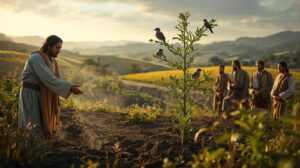
How startling, then, to turn to the Gospel and hear Jesus speak of the Kingdom of God. He uses two simple parables. The first: a man scatters seed, then goes about his life. The seed grows “he knows not how.” The earth produces of itself, first the blade, then the ear, then the full grain. The second: the mustard seed, “the smallest of all seeds,” which grows into a large shrub, offering shelter for birds.
These parables are a profound comfort, especially in light of David’s failure. They teach us that the growth of God’s Kingdom—in the world and in our own souls—does not depend solely on our constant, flawless effort. It is a work of God’s grace. The seeds of Baptism, the Word, and the Eucharist have been planted in us. Even when we are asleep, even after we have failed like David, God’s life within us is quietly at work. The process is often hidden (“he knows not how”), but it is sure. From the smallest, most humble beginnings—a moment of repentance, a whispered prayer for mercy—God can bring forth great growth.
This is the hope for every sinner. David’s story does not end with this chapter. It leads to the prophet Nathan’s confrontation, to David’s psalm of profound repentance (“Create in me a clean heart, O God”—Ps 51), and to God’s enduring mercy. The mustard seed of repentance grew in him, even after grave sin.
For us, the message is twofold. First, a warning: guard against the idleness and privilege that can lead to temptation. Stay faithful to your daily duty. Second, a great comfort: do not despair of your own slow progress or even your falls. The Kingdom grows by God’s power, not merely our own. Our part is to scatter the seeds of prayer and virtue, to repent when we fail, and to trust in the hidden, patient work of God.
As St. Augustine, who knew his own dramatic conversion, wrote, “Trust the past to God’s mercy, the present to God’s love, and the future to God’s providence.” Let us tend the soil of our hearts, repent of our sins, and trust in the quiet, miraculous growth of the Kingdom within us, confident that He who began this good work will bring it to completion. Amen.
May God bless you all!