Friday of the Thirty-fourth Week in Ordinary Time, November 28, 2025
The Kingdom That Will Not Pass Away
Dan 7:2-14; Psalm Dan 3; Lk 21:29-33
Dear Sisters and Brothers in Christ, as the liturgical year draws to a close, the Church directs our gaze toward the ultimate horizon of our hope: the eternal and indestructible Kingdom of God. In a world of constant change and uncertainty, the Word of God today offers us an anchor for the soul—a vision of a reality that alone endures forever.
The Prophet Daniel is granted a breathtaking night vision. He sees the chaos of earthly history symbolized by four great beasts, arising from the turbulent sea. They are terrifying in their power, yet their dominion is temporary. Then, the scene shifts to the heavenly throne room, where the Ancient One takes His seat for judgment. The final beast is slain, and its power is taken away. Then, Daniel sees “one like a son of man coming on the clouds of heaven.” This human-like figure, in stark contrast to the beastly empires, is presented before the Ancient One and is given “dominion, glory, and kingship” that is everlasting and universal. This is not merely a vision of a future Messiah; it is a revelation of a new kind of power—a humane, just, and eternal sovereignty that will triumph over the brutal, chaotic forces of this world.
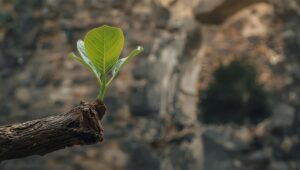
This majestic vision finds its fulfillment and its interpretation on the lips of Jesus Himself. In the Gospel, He uses a simple, earthy image—the fig tree. “When you see its buds burst open,” He says, “you know that summer is near.” The budding tree is a sign of what is already happening, a promise of what is certainly to come. Jesus applies this to His own words about the passing of heaven and earth: “Amen, I say to you, this generation will not pass away until all these things have taken place. Heaven and earth will pass away, but my words will not pass away.” The “things” that must take place are the birth pangs of the new age, including the destruction of Jerusalem, which prefigures the final shaking of all things. But His words—the promise of His Kingdom and His victory—are more solid and lasting than the cosmos itself.
The “one like a son of man” in Daniel’s vision is Jesus Christ. He is the true Adam, the head of a new humanity, who has received from the Father an everlasting kingdom—the Church, which is the seed and beginning of His reign on earth. The beasts represent the rise and fall of all earthly powers that oppose God, from ancient empires to modern ideologies. They all have their day and then vanish. But the Kingdom of Christ, though often hidden and seemingly weak, is the one reality that will never be destroyed.
As Pope Benedict XVI taught, “The Kingdom of God is God’s own active presence in the world, a presence that transforms it from within.”
This is our comfort and our strength. When we see instability in the world, turmoil in the Church, or fear in our own hearts, we are called to remember the vision of Daniel and the promise of Christ. We are citizens of a Kingdom that cannot be shaken. Our task is to learn the signs of its growth, like the buds on a fig tree—to see God’s grace at work even in difficult times and to hold fast to His word above all else.
Let us, then, live not in fear of the beasts, but in hope of the Son of Man. Let us place our trust in His eternal words, and commit ourselves to building up His everlasting Kingdom through faith, hope, and love. For His kingship is our peace, and His word is our everlasting hope. Amen.
May the souls of the faithful departed, through the mercy of God, rest in peace. Amen.