
Good Friday of the Lord’s Passion, April 3, 2026
The Silent Victory: Beholding Our Salvation
Voice over by Eliz
Isa 52:13–53,12, Psalm: 30, Heb 4:14-16; 5:7-9, Jn 18:1—19:42
My dear sisters and brothers in Christ,
We come today to a place where words fail. We gather not around a table, but before a cross. This is Good Friday, and the Church invites us into the paradox of faith: we call this day “good” because on it, the worst that humanity could do became the best that God could give. Today, we behold our salvation.
The prophet Isaiah, centuries before the event, paints a portrait so vivid it seems he stood at Calvary. “He was spurned and avoided by men, a man of suffering, accustomed to infirmity… Yet it was our infirmities that he bore, our sufferings that he endured.” The Suffering Servant is not suffering for His own sins; He is carrying ours. “He was pierced for our offenses, crushed for our sins… by his stripes we were healed.” Isaiah forces us to confront the truth: we are the cause of this suffering. Our pride, our selfishness, our betrayals—these are the thorns, the nails, the spear. Yet, in the mystery of God’s love, the Servant “gave himself up to death” willingly, interceding for the very ones who crucified Him.
The Letter to the Hebrews gives us the theological heart of this mystery. “We do not have a high priest who is unable to sympathize with our weaknesses, but one who has similarly been tested in every way, yet without sin.” Jesus is not a distant God observing our pain from afar. He entered it. He felt abandonment, betrayal, physical agony, and the weight of the world’s sin. Therefore, “we may confidently approach the throne of grace to receive mercy.” Our High Priest knows our struggle because He lived it. His suffering opens the door to our mercy.
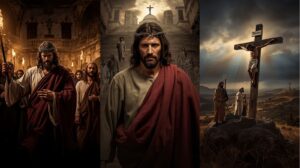
Saint John’s Gospel then leads us through the Passion step by step. We see Jesus arrested in the garden, standing calmly before armed guards. We see Him before Annas and Caiaphas, before Pilate, crowned with thorns, clothed in a mocking purple robe. Pilate presents Him: “Behold, the man!” And the crowd roars, “Crucify him!” We hear the final words from the cross: “It is finished.” And we see the soldier pierce His side, bringing forth blood and water—the sacraments of the Church flowing from the heart of Christ.
Throughout this entire ordeal, notice Jesus’ posture. He does not fight. He does not run. He does not curse. He is the silent Lamb led to slaughter, exactly as Isaiah foretold. His silence is not weakness; it is the strength of divine love holding back the legions He could summon, choosing instead to drink the cup of the Father’s will to its dregs.
Pope Benedict XVI wrote, “Jesus’ cry on the cross, ‘My God, my God, why have you forsaken me?’ is not the cry of one in despair, but the prayer of the Son who brings the world’s pain before the Father.” St. Augustine reminds us, “The cross was the pulpit from which Christ preached His love.”
What does this mean for us? It means we are invited to stop averting our eyes. Today, we look upon the one we have pierced. We do not look with guilt that paralyzes, but with gratitude that transforms. For in that face, disfigured by suffering, we see the face of Love itself. In those wounds, we see our healing. In that death, we see our life.
As you venerate the cross today, touch it. Kiss it. Let it embrace you. For the wood that held His body now holds your salvation. And when you leave this church, carry that cross in your heart. Let the silent victory of this day become the quiet strength of your every tomorrow. Amen.
May God bless you all!