Holy Thursday (Lord’s Supper), April 2, 2026
The Gift Before the Cross: Love Made Visible
Voice over by Eliz
Exod 12:1-8.11-14, Psalm: 115, 1Cor 11:23-26, Jn 13:1-15
My dear sisters and brothers in Christ,
Tonight, we enter the sanctuary of Holy Thursday, the gateway to the Sacred Triduum. In the quiet of this evening, before the shadows of Golgotha descend, Jesus gives us everything. He gives us three inseparable gifts: the gift of the priesthood, the gift of the Eucharist, and the gift of humble service. These are not mere symbols; they are His enduring presence, His continued sacrifice, and His abiding commandment.
Our first reading takes us back to the first Passover in Egypt. The Israelites, still in bondage, receive God’s instruction through Moses. They are to select an unblemished lamb, sacrifice it, and mark their doorposts with its blood. They are to eat it in haste, with loins girded, sandals on their feet, ready for the journey. “This day shall be a memorial feast for you,” the Lord declares, “which all your generations shall celebrate with pilgrimage to the Lord, as a perpetual institution.” The blood of the lamb saves them from the destroyer. The Passover meal becomes their enduring memory of God’s saving power.
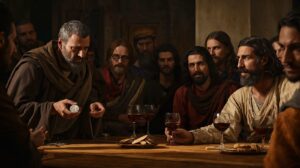
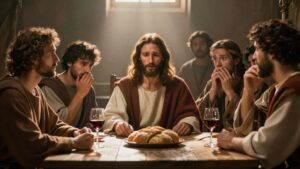
Centuries later, in an upper room in Jerusalem, Jesus celebrates that Passover with His disciples. But something revolutionary occurs. Saint Paul, writing to the Corinthians, passes on what he received from the Lord: “The Lord Jesus, on the night he was handed over, took bread, and, after he had given thanks, broke it and said, ‘This is my body that is for you. Do this in remembrance of me.’ In the same way, also the cup, after supper, saying, ‘This cup is the new covenant in my blood. Do this, as often as you drink it, in remembrance of me.'” The lamb of the Exodus finds its fulfillment. Jesus is the new, unblemished Lamb. His blood will mark not doorposts, but the cross. His sacrifice will save us not from temporal death, but from eternal separation from God.
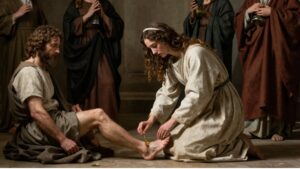
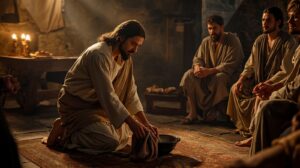
Then, Saint John’s Gospel reveals the heart beneath the gift. Jesus, knowing that the Father had given all things into His hands, and that He came from God and was returning to God, does something shocking. He rises from the table, takes a towel, and begins to wash the disciples’ feet. The Master becomes the servant. He performs the task of the lowliest slave. Peter, in his impetuous humility, protests. But Jesus insists: “Unless I wash you, you will have no inheritance with me.” The cleansing He offers is not just physical; it is the purification we need to share in His life.
Afterward, He explains: “I have given you a model to follow, so that as I have done for you, you should also do.” The Eucharist we receive must be lived. The Body broken for us compels us to be broken for others. The Blood poured out demands that we pour ourselves out in humble service.
Pope Benedict XVI beautifully captured this unity: “The Eucharist is the sacrament of the transformation of our lives. It is not a private, pious devotion. It is a sharing in the self-giving love of Jesus.” St. Augustine called this the “sacrament of piety, the sign of unity, the bond of charity.”
Tonight, we are not spectators of an ancient event. We are participants. In every Mass, we are in that upper room. We receive the same Body, drink from the same Cup. And we are called to the same towel and basin. As we adore the Eucharist in the silence of this night, let us ask ourselves: Do I allow Jesus to wash my feet—to cleanse me in confession, to heal my pride? And do I go from here to wash the feet of others—through humble service, through forgiveness, through love that costs?
The Lamb was slain. The gift was given. Now, it is our turn to live the gift. Amen.
May God bless you all!