Monday of the Eighteenth Week in Ordinary Time, August 4, 2025
The Burden, the Bread, and the Burning Heart of the Curé
Num 11:4b-15, Psalm: 80, Mt 14:13-21
Dear brothers and sisters, today we honor St. John Vianney, the Curé of Ars—a humble priest who became a living icon of Christ’s compassion and tireless love for souls. Our readings reveal two profound truths: the crushing weight of spiritual leadership (Num 11) and God’s miraculous provision for His people (Mt 14). In both, we discover the heart of every priest—and indeed, every disciple—called to surrender exhaustion to God and become vessels of His abundance.
In today’s first reading, the Israelites, wandering in the desert, weep with nostalgia for Egypt’s fleeting comforts. Moses, burdened by their ingratitude and the immense weight of leadership, cries out to God in raw desperation: “Why do you treat your servant so badly?… I cannot carry all these people by myself, for they are too heavy for me!” (Num 11:11,14). His anguish echoes the isolation of every shepherd who feels inadequate before the flock’s needs.
Moses’ lament is not a failure of faith but a prayer of radical trust. He lays his exhaustion before God, refusing false self-reliance. The Church sees here a prefiguring of Christ, the ultimate Shepherd who bears the weight of humanity’s sins (Is 53:4). Pope Francis reminds priests: “A good shepherd knows his sheep, but also lets himself be known by them… sharing their burdens and anointing their wounds” (Homily, Chrism Mass 2022). Moses shows us that holy leadership begins in vulnerability before God.
St. John Vianney knew this exhaustion intimately. Plagued by feelings of inadequacy, he fled Ars three times, only to return out of obedience. He spent 16+ hours daily in the confessional, bearing the spiritual burdens of thousands. Yet he declared: “The priesthood is the love of the Heart of Jesus.” His strength flowed not from himself, but from surrendering his fatigue to God—just as Moses did.
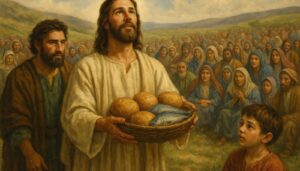
In today’s Gospel, amid Christ’s grief over John the Baptist’s death, crowds pursue Him. Moved by compassion, He heals their sick. When disciples urge Him to dismiss the hungry multitude, Jesus responds: “Give them some food yourselves” (Mt 14:16). With five loaves and two fish—blessed, broken, and given—He feeds thousands, with twelve baskets left over.
This miracle foreshadows the Eucharist—the ultimate “bread from heaven” (Jn 6:32-35). The disciples’ doubt (“We have only five loaves…“) mirrors our own when faced with scarcity. Yet Christ reveals that all offerings, entrusted to Him, become superabundant. Pope Benedict XVI taught: “The Eucharist is God’s response to the deepest hunger of the human heart… the living and enduring presence of Christ among us” (Sacramentum Caritatis, 1). The twelve baskets signify the Church’s mission to feed all nations.
Like Moses and St. John Vianney, pour out your exhaustion, doubt, or feelings of inadequacy to God. He does not scorn holy lament but transforms it. “Cast all your anxieties on Him, for He cares about you” (1 Pt 5:7).
Dear Sisters and Brothers in Christ, bring God your weariness. Offer Him your scarcity. Then watch—as He did with Moses, with the disciples, and with the Curé of Ars—as He turns your trembling “I cannot” into a resounding “God can.” For when we surrender our poverty to the God of superabundance, “nothing will be impossible” (Lk 1:37). St. John Vianney, pray for us! Amen.
St. John Vianney became “living bread” for Ars. Though intellectually unremarkable, his burning love for souls transformed a spiritually desolate village. He fed them with the Eucharist, preached with holy simplicity, and offered his own life as a sacrifice.
As St. Thérèse of Lisieux observed: “Love alone makes apostles.” The Curé’s “five loaves” were his poverty, humility, and tireless confession—multiplied by grace into a harvest of conversions.