
Monday of the Twenty-first Week in Ordinary Time, August 25, 2025
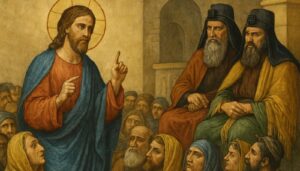
Life-giving testament vs a dead-end that blocks the way
1Thess 1:1-5.8b-10, Psalm: 149, Mt 23:13-22
My dear brothers and sisters in Christ,
In the spiritual life, we are presented with two models, two contrasting portraits of what it means to be a believer. One is a life-giving testament that draws others to God; the other is a dead-end that blocks the way for others. Today, through St. Paul’s joy and Christ’s righteous anger, the Holy Spirit invites us to examine which model defines our own faith.
We begin in Thessalonica, where St. Paul paints a breathtaking icon of a vibrant, authentic Christian community. He doesn’t commend them for their perfect theology or flawless execution of the law. He praises their “work of faith,” their “labor of love,” and their “endurance in hope.” Notice the active, dynamic verbs: work, labor, and endurance. Their faith was not a passive inheritance or a list of intellectual assents; it was a powerful force that worked through charity and was sustained by hope. It was a faith that spread—Paul says, “the word of the Lord has sounded forth from you.” They became “a model for all the believers.” Their lives were so transformed, so evidently filled with the “power and the Holy Spirit,” that they became a magnet, drawing others to “serve the living and true God.” This is evangelization not by argument, but by attraction.
This beautiful portrait stands in stark contrast to the searing critique Jesus levels in the Gospel. He speaks not to pagans or atheists, but to the most religious people of his day: the scribes and Pharisees. His accusation is devastating: “You lock the Kingdom of heaven before human beings.” How does one lock the Kingdom? Not with physical keys, but with spiritual obstacles. Jesus names their hypocrisy: their meticulous tithing of garden herbs while neglecting “justice and mercy and faith”; their zeal for making converts only to mold them into versions of themselves—children of “Gehenna”; their obsession with oaths and loopholes that misses the entire point of a promise, which is integrity.
Their faith was not a “work” that served others, but a performance that served their own ego. It was not a narrow gate leading to life, but a series of locked doors blocking the way for others. They were not a model of hope, but a scandal that drove people away. Their religion was a closed system of external observance, utterly devoid of the “power and the Holy Spirit” that filled the Thessalonians.
So, the question for us is stark: Does our faith attract or does it block? Are we a living testament like the Thessalonians, or a stumbling block like the Pharisees?
Perhaps the Holy Spirit is asking us to examine our “labor of love.” Is our service in the parish, our work in the family, done with the grumbling sense of obligation of the Pharisee, or with the joyful, self-giving love that characterized the Thessalonian church? As St. Mother Teresa often said, “It is not how much we do, but how much love we put in the doing.”
Perhaps we are being called to check for “locked doors” in our own lives. Do our attitudes, our gossip, our cynicism, or our refusal to forgive become a barrier that makes it harder for our children, our coworkers, or our friends to believe in the love of God? Do we present a faith that is all rule and no joy, all burden and no freedom? Pope Francis constantly warns against this, saying, “I prefer a Church which is bruised, hurting and dirty because it has been out on the streets, rather than a Church which is unhealthy from being confined and from clinging to its own security.”
The comfort today is that we are not left to our own devices to become a Thessalonian. Paul reminds them they were “chosen” by God, and that the Gospel came to them “in power and in the Holy Spirit.” The same Spirit is given to us! The same power is available in the Eucharist! The narrow gate is not locked from the outside; it is opened from the inside by Christ, and our baptism is the key.
Let us pray for the courage to be a model. Let our faith be a dynamic force of love that sounds forth from this parish. Let us strive to ensure that the only thing we are known for is our work of faith, our labor of love, and our endurance in hope, so that all who know us may turn, as the Thessalonians did, to wait for the Son from heaven, our Lord Jesus Christ. Amen.