

Saturday of the Twenty-first Week in Ordinary Time, August 30, 2025
The Currency of Love: Investing Our God-Given Gifts
1Thess 4:9-11, Psalm: 97, Mt 25:14-30
My dear sisters and brothers in Christ,
In the economy of God’s kingdom, we are all given capital—not merely material wealth, but the profound gifts of time, talent, and love. Today’s readings present a compelling vision of what we are to do with this divine investment. They call us beyond a safe, minimalistic faith into one of courageous growth and self-giving charity.
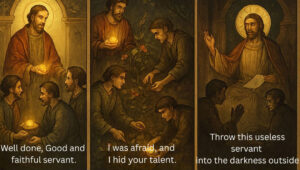
The Gospel presents us with the dramatic Parable of the Talents. A man entrusts his servants with his property, each “according to his ability.” The key to the parable is the nature of the trust. The master does not give a detailed manual; he gives an opportunity. He expects initiative, courage, and a return on his investment. The first two servants understand this. They immediately go and trade, doubling what was given. They are not afraid of risk because they operate out of a relationship of trust with the master. Their reward is breathtaking: entry into the “joy of your master,” and greater responsibility in the eternal kingdom.
The third servant, however, operates out of fear. He sees the master not as generous and trusting, but as “a demanding person.” This distorted image paralyzes him. He buries the talent, preserving it perfectly but rendering it utterly fruitless. His fear leads not to safety, but to condemnation. He is cast out into the darkness for failing the one fundamental requirement: to do something with the gift he was given. In the words of Pope Francis, “A faith that does not bear fruit, that does not do good deeds, is a faith that is dead… It is merely spoken, not lived.”
This call to fruitful action is perfectly complemented by St. Paul’s exhortation to the Thessalonians. He praises them because they have been “taught by God to love one another.” And indeed, they do love all throughout Macedonia. But then Paul gives a surprising instruction: “But we urge you, brothers and sisters, to progress even more, and to aspire to live a tranquil life, to mind your own affairs, and to work with your own hands.” This is not a contradiction. For Paul, the ultimate “return on investment” for a Christian is often manifested in the quiet, ordered, and diligent practice of charity in daily life. The “talent” of love is not meant for grand, dramatic displays alone, but to be invested in the humble, patient, and often unseen work of building up the community—of providing for one’s family, of doing one’s job with integrity, and of living peaceably with all.
This is where the two readings unite. God has given each of us talents. For some, it may be a gift for teaching, for music, for leadership. For all of us, without exception, it is the talent of love, received at our baptism. The question is: do we invest it or bury it?
Do we bury our capacity to love out of fear? Fear of rejection, fear of being taken advantage of, fear that our small contribution won’t matter? Or do we, like the faithful servants, immediately set to work? We invest it by forgiving a long-held grudge, by patiently listening to a lonely neighbor, by faithfully fulfilling the duties of our state in life with a cheerful heart, by offering up our daily burdens for the salvation of souls.
St. Thérèse of Lisieux mastered this “little way” of investing everything, no matter how small, with great love. She teaches us that “Our Lord does not look so much at the greatness of our actions, nor even at their difficulty, but at the love with which we do them.”
The master in the parable is, of course, Christ. And He is not a harsh taskmaster. He is the one who entrusted us with His very life. He does not demand we all achieve the same results, but that we all show the same courage and generosity with what we have been given. He does not call us to be successful, but to be faithful.
So let us examine our hearts. What talent has God placed in my hands? However small it may seem, let us resolve today to no longer bury it in the ground of fear, self-pity, or complacency. Let us dig it up and put it into circulation through acts of love. For in the end, we will be judged not on how much we amassed, but on how courageously we loved with all that we were given. Amen.