Sixth Sunday in Ordinary Time (A), February 15, 2026

The Greater Righteousness: From Rule-Keeping to Heart-Transformation
Voice over by Carol San San Lwin
Sir 15:16-21, Psalm: 118, 1Cor 2:6-10, Mt 5:17-37
My dear Sisters and Brothers in Christ,
If we were to summarize the spiritual life in a single question, it might be this: Is my faith a matter of checking boxes, or is it a matter of a transformed heart? Today, the Word of God takes us from the foundational gift of human freedom, through the astonishing wisdom of God’s plan, and into the demanding—and liberating—call to a holiness that reaches into the very depths of our thoughts and desires.
The Book of Sirach begins with a profound truth about our dignity. “Before man are life and death, good and evil, whichever he chooses shall be given him.” God, who is “all-seeing,” does not force our hand. He has set before us water and fire, a choice. “To none does he give license to sin,” yet He respects our freedom. This establishes the solemn backdrop: we are moral agents, responsible for our choices. Our spiritual journey starts with the acknowledgment that we are free to choose the good, and we will be held accountable.
But what is the “good”? Our human wisdom often falls short. This is where Saint Paul’s majestic words to the Corinthians come in. He speaks of a “wisdom” not of this age, a “hidden wisdom of God” that “none of the rulers of this age knew.” This is the revolutionary plan of salvation through the Cross—a plan so loving, so unexpected, that “eye has not seen, and ear has not heard… what God has prepared for those who love him.” This wisdom is revealed to us by the Holy Spirit, who “scrutinizes everything, even the depths of God.” Therefore, the blueprint for the “good life” is not a human construct, but a divine revelation.
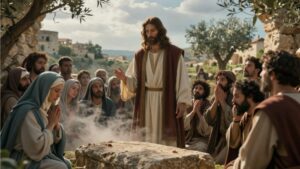
This divine wisdom finds its most challenging expression in today’s Gospel from the Sermon on the Mount. Jesus declares, “Do not think that I have come to abolish the law or the prophets. I have come not to abolish but to fulfill.” Then He proceeds to reveal the law’s radical, interior dimension.
It’s not enough to not kill; we must root out unjust anger and seek reconciliation. It’s not enough to not commit adultery; we must purify our hearts of lustful desires. He calls for absolute integrity: “Let your ‘Yes’ mean ‘Yes,’ and your ‘No’ mean ‘No.’” Jesus is not adding more rules. He is revealing that the Law’s true aim is to shape a heart that mirrors the Father’s own heart—a heart of purity, peace, and undivided truth. This is the “greater righteousness” that surpasses that of the scribes and Pharisees.
Here is the powerful convergence of today’s readings. We are free to choose (Sirach). God’s revealed wisdom shows us that the goal is love and holiness, not minimal compliance (1 Corinthians). And Jesus, the incarnate Wisdom of God, defines that holiness as an interior transformation that goes to the root of our thoughts and motivations (Matthew).
For us, this means moving from a spirituality of “What’s the minimum I have to do?” to “How fully can I love?” It’s the difference between avoiding murder and actively being a peacemaker. Between avoiding adultery and cultivating a heart that sees others with dignity. Between technically keeping oaths and being a person of such integrity that your word is your bond.
This is impossibly high, if we rely on our own strength. But that’s the point. The “greater righteousness” is a work of grace. It is the Holy Spirit, who knows the depths of God, working in the depths of our hearts. We access this grace through prayer, the Sacraments—especially Reconciliation and the Eucharist—and the daily practice of virtue.
As Pope Benedict XVI taught, “The saints are the true interpreters of Holy Scripture. The meaning of a given passage of the Bible becomes most intelligible in those human beings who have been totally transfixed by it and have lived it out.” Let us look to the saints, who show us this “greater righteousness” is possible.
St. Augustine, who knew the long struggle of a divided heart, prayed, “Grant what you command, and command what you will.” God gives the command and the grace to fulfill it.
So today, let us embrace our freedom with sober joy. Let us ask the Holy Spirit to pour God’s own wisdom into our hearts. And let us cooperate with that grace, allowing Christ to transform us from the inside out, so that our every thought, word, and deed may become a living fulfillment of His law of love. Amen.
May God bless you all!