
Thursday of the Fifth Week in Ordinary Time, February 12, 2026
The Humble Faith That Claims the Promise
Voice over by Carol San San Lwin
1Kgs 11:4-13, Psalm: 105, Mk 7:24-30
My dear Sisters and Brothers in Christ,
The Scriptures today present us with a study in contrasts: one person who had everything but lost the promise through a divided heart, and another who had nothing but claimed the promise through a humble and persistent faith. Through the tragic decline of Solomon and the astonishing faith of a Gentile woman, we are taught that God’s promises are secured not by our status, but by our fidelity.
The First Book of Kings delivers a sobering account. King Solomon, the wisest of men, blessed with an unimaginable divine promise, falls into ruin because “his heart was not entirely with the Lord.” He permitted his many foreign wives to turn his heart to other gods. The Lord, who had appeared to him twice, declares, “Since this is what you want… I will deprive you of the kingdom.” Solomon’s tragedy is a slow turning—a heart divided by competing loyalties, compromising with the world until the promise is forfeited. It is a warning that our greatest spiritual danger is not sudden collapse, but gradual erosion.
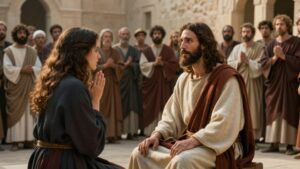
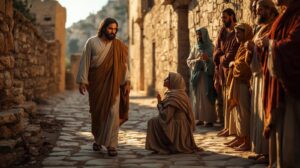
This makes the encounter in the Gospel of Mark so shocking and beautiful. Jesus enters Gentile territory, seeking seclusion. A Syrophoenician woman, a pagan outsider, approaches Him, begging Him to drive a demon from her daughter. Jesus’ response seems harsh: “Let the children be fed first. For it is not right to take the food of the children and throw it to the dogs.” In that culture, “dogs” was a derogatory term for Gentiles.
But the woman does not take offense or walk away in pride. In an act of breathtaking humility and theological insight, she accepts the analogy and turns it into a plea: “Lord, even the dogs under the table eat the children’s scraps.” She acknowledges the priority of Israel (the children), but asserts that God’s mercy is so abundant there is enough even for the “dogs” like her. She argues from the logic of grace itself. Jesus is moved: “For saying this, you may go. The demon has gone out of your daughter.” Her humble, persistent faith claims the healing that Solomon’s divided heart lost.
Here is the lesson for us. Solomon assumed the promise was his by right, and grew lax. The woman knew she had no claim, and threw herself on mercy. Her faith was active, humble, and tenacious.
We must ask ourselves: Is my heart entirely with the Lord, or is it divided by other loyalties—to comfort, to success, to the approval of the world? Do I approach God with a sense of entitlement, or with the humble, persistent faith of the Syrophoenician woman?
St. Augustine, reflecting on this Gospel, saw in this woman a model for the Gentile Church: “She was not insulted by being called a dog; she did not demand to be treated as a child; but she admitted she was a dog, and asked for crumbs.” This is the posture of every sinner before God.
The comfort today is immense. No matter how far we may have wandered, no matter our background or failures, God’s mercy has abundant “crumbs”—more than enough for us. We need only approach Him with a heart undivided by pride, trusting completely in His goodness.
Let us pray for the grace of a faithful and humble heart, that we may hold fast to His promises and always find a share in the bounty of His grace. Amen.
May God bless you all!