Thursday of the First Week in Ordinary Time, January 15, 2026
When God Is Not a Tool
Voice over by Carol San San Lwin
1Sam 4:1-11, Psalm: 43, Mk 1:40-45
My dear Sisters and Brothers in Christ,
We can sometimes approach our faith as if God were a force to be harnessed or a formula to guarantee success. We can subtly treat prayer, sacraments, or sacramentals like spiritual tools to achieve our desired outcomes. Today’s readings present a stark contrast between this dangerous temptation and the transformative power of a faith rooted in humble surrender.
The first reading from Samuel is a spiritual tragedy. The Israelites are at war with the Philistines and suffer a defeat. Their solution? Fetch the Ark of the Covenant from Shiloh, believing its presence alone will guarantee victory. They treat the Ark—the sign of God’s holy presence among His people—not with reverent awe, but as a lucky charm, a divine weapon to be deployed. They shout with presumptuous confidence when it arrives. But God will not be used. The Israelites are routed, the Ark is captured, and the sons of Eli are killed. It is a devastating lesson: God is not a tool to serve our plans. When we seek to manipulate His power rather than submit to His will, we court disaster.
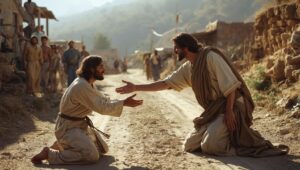
This makes the encounter in the Gospel all the more breathtaking. A leper, the ultimate outcast, approaches Jesus. In an act of profound faith and humility, he does not demand, “You must heal me.” Instead, he kneels and surrenders completely: “If you wish, you can make me clean.” His faith is in Jesus’ power, but he submits entirely to Jesus’ will. Moved with pity, Jesus stretches out His hand—touching the untouchable—and says, “I do will it. Be made clean.” Here is the true dynamic of faith: not trying to control God, but trusting in His goodness and surrendering to His compassionate will. The leper is made whole.
These two scenes pose a vital question for our spiritual lives: Do we approach God like the Israelite generals or like the leper? Do we treat our faith as a transaction, or as a relationship of trust?
How does this temptation appear? It can surface when we bargain in prayer (“God, if you grant this, I’ll go to Mass more”), or when we reduce the sacraments to rituals of obligation without conversion of heart, or when we treat blessed objects as magical amulets rather than reminders of God’s grace.
The true path is the leper’s path. It is the path of St. Thérèse of Lisieux, who taught the “little way” of spiritual childhood—a total trustful surrender to God’s loving will. It is the path echoed by Jesus Himself in Gethsemane: “Not my will, but yours be done.”
The comfort today is immense. Jesus wills our cleansing, our healing, our holiness. He is not a distant power to be manipulated, but a compassionate Savior who draws near to touch our deepest wounds. We don’t need to shout to get His attention like the Israelites; we need to kneel in trust like the leper.
Let us examine our hearts. Where are we trying to use God for our purposes? Let us instead offer Him our needs with the leper’s humble trust: “Lord, if you wish, you can…” and then be ready to accept His will, knowing that His will for us is always love, always healing, and always our truest good. Amen.
May God bless you all!