
Tuesday of the Thirty-third Week in Ordinary Time, November 18, 2025
The Integrity of Our Yes
Voice over by Angeline Chue Chue
2Macc 6:18-31; Psalm: 3; Lk 19:1-10
Dear Sisters and Brothers in Christ, the Word of God today presents us with two very different men, each at a critical crossroads. Their stories reveal a profound truth: our faithfulness to God is measured not in a single grand gesture, but in the daily, concrete choices that form a life of integrity, a life where our actions finally say “yes” to the God we claim to believe in.
In the Second Book of Maccabees, we meet Eleazar, a ninety-year-old man, “a priest of fine appearance and advanced age.” He is forced to choose between saving his life by pretending to eat pork—thus publicly betraying the Law of God—or remaining faithful and facing a torturous death. His friends urge him to pretend, to go through the motions without truly meaning it. But Eleazar refuses this compromise. He declares he will act “as befits my age,” leaving the young “a noble example of how to die a good death willingly and nobly for the revered and holy laws.” His death is not a rejection of life, but the ultimate affirmation of his faith. His final act is one of total coherence: what he believed in his heart, he confirmed with his body.
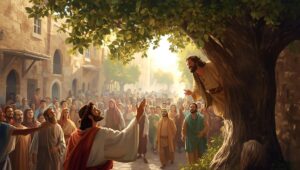
This theme of a life made coherent by a decisive choice finds its joyful echo in the Gospel. Zacchaeus, the chief tax collector and a man deeply compromised by collaboration with the Romans, is curious about Jesus. His desire is so great that he climbs a tree just to see over the crowd. When Jesus calls him and invites Himself to his house, the crowd grumbles, judging Zacchaeus by his past. But this encounter with the Lord’s mercy sparks an immediate and concrete conversion. Zacchaeus doesn’t just feel sorry; he stands and declares, “Behold, half of my possessions, Lord, I shall give to the poor, and if I have extorted anything from anyone I shall repay it four times over.” His faith becomes active in justice. His interior “yes” to Christ is validated by an external, sacrificial “yes” to his neighbor. Jesus confirms this, declaring, “Today salvation has come to this house.”
These two men, one old and revered, the other a sinner and outcast, teach us the same Catholic truth: faith must be incarnate. It must touch the ground of our daily decisions. Eleazar’s faithfulness unto death and Zacchaeus’s conversion through restitution are two sides of the same coin of integrity. As Pope Francis teaches, “Faith is not a light which scatters all our darkness, but a lamp which guides our steps in the night and this is enough for the journey.”
The comfort for us is that God meets us where we are. He honors the quiet, lifelong fidelity of an Eleazar and races to the home of a repentant Zacchaeus. The challenge is to examine the coherence of our own lives. Where are the gaps between what we believe and how we act? Do we make compromises for the sake of comfort or social acceptance? Does our faith translate into concrete justice, especially in our finances and relationships?
Let us ask for the grace of a coherent faith. May we, like Eleazar, have the courage to be faithful in the small and large tests of life, and like Zacchaeus, the humility to make concrete amends where we have failed. For the Lord seeks us out today, longing to bring salvation to our house, if only we will offer Him the integrity of our “yes.” Amen.
May the souls of the faithful departed through the mercy of God rest in peace. Amen.