
Tuesday of the Twenty-ninth Week in Ordinary Time, October 21, 2025
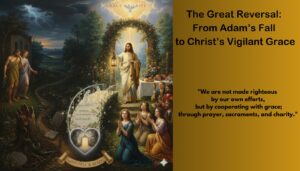
The Great Reversal: From Adam’s Fall to Christ’s Vigilant Grace
Rom 5:12.15b.17-19.20b-21, Psalm: 39, Lk 12:35-38
My dear Sisters and Brothers in Christ,
The human story, as told by Scripture, is one of a great chasm opened by sin, and a greater bridge built by grace. Today, St. Paul unveils the breathtaking scope of this divine drama, while the Lord Jesus tells us how to live in the light of its conclusion. Together, they offer us profound comfort and a stirring call to vigilance.
Paul presents a powerful contrast between two representative figures: Adam and Christ. “Through one man sin entered the world,” he writes, “and through sin, death.” Adam’s disobedience was a catastrophe with universal consequences. It introduced a fundamental brokenness into our human nature, a tendency toward sin that we all inherit. But Paul’s message is not one of despair. It is a proclamation of a victory so immense that it overwhelms the defeat. “If by that one person’s transgression the many died,” he exclaims, “how much more did the grace of God and the gracious gift of the one man Jesus Christ overflow for the many!”
This is the heart of the good news. The power of God’s grace in Christ is infinitely greater than the power of Adam’s sin. Where sin increased, Paul says, grace overflowed all the more. The obedience of Jesus on the Cross—His perfect “Yes” to the Father—reverses the eternal consequences of Adam’s “No.” Through one man, condemnation came for all; through the New Adam, “acquittal and life came to all.” This is the foundation of our hope: we are not ultimately defined by our failures or our fallen nature, but by the superabundant gift of grace offered to us in Jesus Christ.
This monumental truth, however, is not meant to make us passive. It is meant to make us ready. The Gospel paints a vivid picture of this readiness. Jesus tells his disciples to “gird your loins and light your lamps,” like servants awaiting their master’s return from a wedding. They do not know the hour, so they must stay alert. The stunning promise is that when the master finds them vigilant upon his arrival, “he will gird himself, have them recline at table, and proceed to wait on them.” The master becomes the servant.
This image reveals the incredible dignity bestowed upon the vigilant soul. The one who waits in faithful expectation, whose life is oriented toward the coming of the Lord, will be served by Christ Himself. This is the goal of the Christian life: intimate communion with the Master. Our vigilance is not a fearful watching for a harsh judge, but a hopeful anticipation of a loving bridegroom.
So, how do we live in this tension between grace received and the call to vigilance? We do not make ourselves righteous through our own watchfulness; that is the work of Christ’s grace, as Paul teaches. But we cooperate with that grace by staying awake. We keep the lamps of our faith lit through prayer, the sacraments, and acts of charity. We gird our loins with the truth, rejecting the lies of the world. As St. Augustine prayed, “You have made us for yourself, O Lord, and our heart is restless until it rests in you.” Our vigilance is this restless heart actively seeking its rest in God.
Pope Benedict XVI captured this beautifully: “Being Christian is not the result of an ethical choice or a lofty idea, but the encounter with an event, a person, which gives life a new horizon and a decisive direction.” That event is the Paschal Mystery; that person is Jesus. Having encountered Him, we are called to live with our loins girded for the journey.
Let us go forth, then, with hearts full of gratitude for the grace that has overflowed for us. And let that gratitude fuel our watchfulness, so that when the Master comes, He may find us ready, waiting, and eager to share in the eternal wedding feast. Amen.