
Twenty-fifth Sunday in Ordinary Time (C), September 21, 2025
The Measure of a Faithful Heart
Amos 8:4-7, Psalm: 112, 1Tim 2:1-8, Lk 16:1-13
Dear Sisters and Brothers in Christ, the Word of God today presents us with a profound and challenging question: where does our ultimate allegiance lie? Through the voice of the prophet, the instruction of an apostle, and the teaching of our Lord, we are invited to examine our relationship with the things of this world and to ensure that God is truly the master of our hearts.
The first reading from the prophet Amos is a searing indictment of false piety and economic injustice. He speaks against those who observe the external forms of religion—longing for the new moon and Sabbath to be over—while their hearts are consumed with greed. Their true intent is to “diminish the ephah, add to the shekel, and fix our scales for cheating.” They exploit the poor, reducing human beings to a commodity to be bought and sold. The Lord’s response is one of righteous anger: “Never will I forget a thing they have done!” This is a powerful reminder that our worship on Sunday must inform our conduct on Monday. There is no separation between the love of God and the just treatment of our neighbor. A faith that does not translate into fairness, compassion, and integrity in our daily dealings is a hollow faith indeed.
This call to integrity and right order continues in the first letter to Timothy. Saint Paul urges that “supplications, prayers, petitions, and thanksgivings be offered for everyone.” This universal prayer has a purpose: “that we may lead a quiet and tranquil life in all devotion and dignity.” Prayer for our leaders and for all people is not merely a spiritual duty; it is a practical act that acknowledges God’s sovereignty over all earthly affairs. It roots us in the truth that there is “one God” and “one mediator between God and men, Jesus Christ,” who gave himself as a ransom for all. In a world fractured by division and the pursuit of power, our prayer is a radical act that declares our primary citizenship is in heaven. It reorients us toward the one thing that truly matters: the salvation God desires for all people.
This reorientation finds its most challenging expression in the Gospel. The Parable of the Dishonest Steward is perhaps one of the most difficult to understand. At first glance, it seems Jesus is praising dishonest behavior. But a closer look reveals a deeper lesson. The steward is not praised for his dishonesty, but for his prudence—his shrewd, urgent foresight. He used the tools at his disposal—worldly wealth—to secure his future. Jesus then draws the stunning application: “I tell you, make friends for yourselves with dishonest wealth, so that when it fails, you will be welcomed into eternal dwellings.”
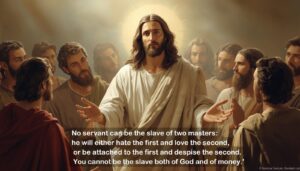
The Lord is not encouraging fraud. He is giving us a profound spiritual principle: use the temporary, unreliable wealth of this world (“mammon”) for eternal purposes. Be as shrewd and creative in pursuing the Kingdom as worldly people are in pursuing their comfort. How? By using our money, our time, and our talents to “make friends” for God—by feeding the hungry, clothing the naked, and supporting the mission of the Church. These acts of mercy store up treasure in heaven. The ultimate lesson is the final line: “You cannot serve God and mammon.” We must choose our master.
The world, like the people in Amos’s time, tells us to serve wealth. But Christ tells us to use wealth to serve God and neighbor. This is the path to true “devotion and dignity.”
So how do we apply this? First, we must examine our business and personal dealings. Are they just and fair, or do we cut corners? Second, we must pray faithfully for our world, remembering that Christ is the one true mediator. Finally, we must ask ourselves: Am I using my worldly resources with holy shrewdness? Does my budget reflect a priority on storing up treasure in heaven?
As Saint John Chrysostom powerfully preached, “Not to share our own wealth with the poor is theft from the poor and deprivation of their means of life; we do not possess our own wealth but theirs.”
May the Holy Spirit give us the wisdom to be prudent stewards of God’s gifts. Let us use the temporary things of this world with justice and generosity, so that we may be found faithful when they fail, and be welcomed into the eternal dwellings prepared for us by our one true Master, Jesus Christ. Amen.