
Twenty-seventh Sunday in Ordinary Time (C), October 5, 2025
The Mustard Seed and the Steadfast Heart: Nurturing a Faith That Endures
Hab 1:2-3; 2:2-4, Psalm: 94, 2Tim 1:6-8.13-14, Lk 17:5-10
My dear Sisters and Brothers in Christ,
In the quiet moments of our lives, when we confront the world’s brokenness or feel the weight of our own spiritual poverty, a prayer often rises from the depths of our hearts, the same one uttered by the Apostles: “Lord, increase our faith!” It is a plea born of both need and hope. Today, the Word of God gives us not a simplistic answer, but a profound and multi-layered blueprint for the kind of faith that truly sustains us—a faith that is steadfast in waiting, active in preservation, and humble in service.
I. The Faith That Waits: Trusting God’s Vision (Habakkuk 1:2-3; 2:2-4)
We begin with the prophet Habakkuk, who gives voice to our deepest lament. His cry is raw and familiar: “How long, O LORD? I cry for help, but you do not listen!” He is surrounded by violence, strife, and injustice. He sees the wicked prospering and the righteous suffering, and he cannot understand God’s silence. This is the first arena of faith: the struggle to believe when evidence seems to point the other way.
God’s response is not an immediate intervention to fix the situation. Instead, He instructs Habakkuk to “Write down the vision; make it plain upon tablets, so that the one who reads it may run.” The vision is a promise of God’s ultimate justice and fidelity. The command that follows is the cornerstone: “Wait for it, it will surely come, it will not be late.” And then comes the defining principle: “The just one shall live by faith.”
This is the first lesson for our own hearts. Faith is not merely believing in God when blessings are evident; it is trusting in His character and His promises when darkness seems to prevail. It is the stubborn, grace-filled choice to cling to the “vision” of God’s goodness and ultimate victory, even when our present circumstances scream the opposite. It is the faith of Job, who declared, “Though he slay me, yet will I hope in him” (Job 13:15). When we are tempted to despair over global conflicts, personal tragedies, or prolonged struggles, God calls us to this steadfast, waiting faith. He is at work, even when He seems silent.
II. The Faith That Acts: Stirring the Flame (2 Timothy 1:6-8.13-14)
If the first step is to wait on God in trust, the second is to actively nurture the gift He has given us. St. Paul, writing from prison to his beloved disciple Timothy, uses a powerful image: “I remind you to stir into flame the gift of God that you have through the imposition of my hands.” Faith is not a static possession, like a trophy on a shelf. It is a divine fire that can dwindle to embers if not tended. It must be stirred, fed, and oxygenated.
How do we stir this flame? Paul gives clear instructions. First, by courage: “For God did not give us a spirit of cowardice, but rather of power and love and self-control. So do not be ashamed of your testimony to our Lord.” We stir the flame by publicly living our faith, even when it is counter-cultural. Second, by guarding “this rich trust with the help of the Holy Spirit that dwells within us.” We preserve the deposit of truth through prayer, the Sacraments, especially the Eucharist and Reconciliation, and through studying the teachings of the Church. Faith, therefore, involves our own effort, our fiat, cooperating with the grace God so generously provides. It is the “work of faith” St. Paul elsewhere describes (1 Thes 1:3).
III. The Faith That Serves: The Power of the Mustard Seed (Luke 17:5-10)
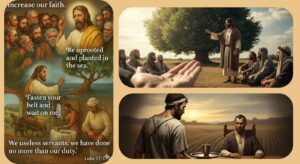
Finally, the Apostles’ request meets Jesus’ surprising response. They ask for an increase, perhaps imagining a more spectacular, feel-good faith. Jesus tells them that even the tiniest seed of genuine faith possesses immense, mountain-moving power. But then He immediately tells the parable of the unprofitable servant. After a servant has plowed and tended sheep, he does not expect special praise from his master. He simply says, “We are unprofitable servants; we have done what we were obliged to do.”
Here is the masterstroke that ties everything together. Jesus links the power of faith with the posture of faith. True, powerful faith is not manifested primarily in spectacular displays that earn us spiritual accolades. It is proven in the humble, faithful, and often unnoticed fulfillment of our daily duties. The greatest demonstration of faith is not necessarily moving mulberry trees, but moving our hearts to serve God and our neighbor with love, patience, and perseverance, without demanding a reward. This is the faith that pleases God—a faith that serves. As St. Mother Teresa, a modern icon of this humble service, famously said, “We are not called to be successful, but faithful.” The power of the mustard seed is revealed in the quiet, often difficult, obedience of everyday life.
A Living, Active Faith
So, the Lord’s answer to our prayer, “Increase our faith!” is a call to a dynamic, three-dimensional discipleship. He calls us to the steadfast faith of Habakkuk, trusting God’s vision in the midst of darkness. He calls us to the active faith of Timothy, stirring into flame the gift of the Spirit through courage and devotion. And He calls us to the humble, serving faith of the unprofitable servant, finding glory not in achievement but in faithful obedience.
When we feel our faith is small, like a mustard seed, let us not despair. Let us instead plant it in the soil of trust, water it with prayer and the Sacraments, and let it grow into a tree of humble service. For this is the faith that will truly sustain us, the faith by which the just shall live, and the faith that will one day hear the words, “Well done, my good and faithful servant… Come, share your master’s joy” (Mt 25:21). Amen.