Twenty-sixth Sunday in Ordinary Time (C), September 28, 2025
The Great Chasm of the Heart
Amos 6:1a.4-7, Psalm: 145, 1Tim 6:11-16, Lk 16:19-31
Dear Sisters and Brothers in Christ, the Word of God today pierces through our illusions of comfort and confronts us with one of the most urgent and sobering questions of our faith: where does our ultimate security lie, and to whom do we belong? Through the prophet’s warning, the apostle’s charge, and the Lord’s parable, we are invited to examine the orientation of our hearts and the eternal consequences of our earthly choices.
The prophet Amos launches a fierce indictment against the “complacent in Zion.” He describes a people obsessed with luxury, gourmet food, fine music, and pampering themselves. They are hedonistic, “anoint themselves with the best oils,” yet are “not made ill by the collapse of Joseph.” Their sin is not merely wealth, but a profound, willful indifference to the suffering of their brothers and sisters. They have built a fortress of comfort that insulates them from the cries of the poor. God’s response is terrifying: “Therefore, now they shall be the first to go into exile.” Their self-imposed exile from solidarity and charity will become their eternal reality.
This warning against spiritual complacency is met with its antidote in Paul’s letter to Timothy. In stark contrast to the pursuit of luxury, Paul issues a militant charge: “But you, man of God, pursue righteousness, devotion, faith, love, patience, and gentleness. Compete well for the faith.” This is a call to active, striving virtue. It is a rejection of passivity. Paul reminds Timothy—and us—of our fundamental identity: we are people “of God,” who have taken hold of “eternal life.” This identity demands a life of intentional pursuit, one that is lived in the radiant presence of Christ Jesus, who “gave testimony” to this truth before Pontius Pilate. Our confession of faith must be active and public.
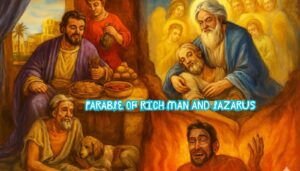
The Gospel presents the ultimate crystallization of this theme in the Parable of the Rich Man and Lazarus. The chasm that the rich man carefully constructed in his earthly life—between his gate and Lazarus, between his purple garments and Lazarus’s sores, between his sumptuous feasts and Lazarus’s longing for scraps—becomes eternalized after death. The great irony and tragedy is that the rich man, who never even saw Lazarus at his gate, now sees him perfectly in Abraham’s bosom. He finally sees, but it is too late. Abraham’s words are definitive: “A great chasm is established to prevent anyone from crossing.” This chasm was not created by God after death; it was dug, day by day, by the rich man’s choices during his life. He had Moses and the prophets; he had the law of charity proclaimed in Amos. He chose not to hear them.
The Church has always taught that our love for God is intrinsically linked to our love for neighbor, particularly the poor. This is not a political stance but a requirement of the Gospel. The corporal works of mercy—feeding the hungry, clothing the naked—are not optional extras for a few specialists; they are the essential criterion by which our faith will be judged (Mt 25). As Saint John Chrysostom thundered, “Not to enable the poor to share in our goods is to steal from them and deprive them of life. The goods we possess are not ours, but theirs.”
The comfort for us is that the chasm is not yet fixed. Today is the day of grace. God gives us His Word, the sacraments, and the witness of the saints to stir us from our complacency. The same Lord who warned us of the chasm also provides the means to bridge it: a heart softened by grace and moved to mercy.
How do we apply this? We must ask for the grace to truly see the Lazarus at our gate. Who is it that I conveniently ignore? The lonely relative? The difficult coworker? The homeless person I pass by? We must then “compete well for the faith” by actively pursuing charity. This means budgeting for almsgiving, volunteering our time, and advocating for the marginalized.
Let us heed the words of Pope Francis: “We must not be afraid to say clearly that we need an economy that is friendly to the poor and not an economy that excludes them.”
May the Holy Spirit shake us from all complacency. May we, pursuing righteousness and love, bridge the chasms we have built with concrete acts of mercy, storing up for ourselves not an exile of emptiness, but the eternal riches of God’s Kingdom. Amen.