
Second Sunday of Easter, Divine Mercy Sunday, April 12, 2026
The Wounds of Mercy: From Doubt to Divine Love
Voice over by Eliz
Acts 4:32-35, Psalm: 117, 1Jn 5:1-6, Jn 20:19-31
My dear sisters and brothers in Christ,
On this Second Sunday of Easter, Divine Mercy Sunday, the Church invites us to gaze upon the wounded heart of our Risen Lord. In a world that often seeks to hide its wounds, Jesus reveals His. In a culture that demands proof before trust, Jesus offers His scars. Today, we encounter the mercy that flows from those wounds—mercy that forgives, unites, and transforms.
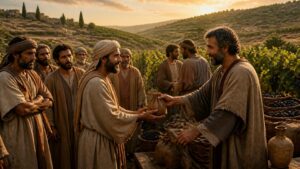
The Acts of the Apostles gives us a breathtaking portrait of the early Church living in the power of that mercy. “The community of believers was of one heart and mind, and no one claimed that any of his possessions was his own, but they had everything in common.” This unity was not a human achievement; it was the fruit of the resurrection. They had encountered the Risen Lord, received His forgiveness, and now they could not help but share everything—their hearts, their possessions, their very lives. “There was no needy person among them.” This is the social dimension of Divine Mercy: a community so transformed by God’s love that it becomes a home for the poor.
Saint John, in his first letter, draws out the practical implications. “Everyone who believes that Jesus is the Christ is begotten by God.” Our faith in the Incarnate Son makes us children of the Father. And how do we prove our sonship? “The way we know that we love the children of God is when we love God and obey his commandments.” Love of God and love of neighbor are inseparable. And what conquers the world? “Our faith.” Not our strength, not our strategies, but our trusting faith in the One who conquered death itself.
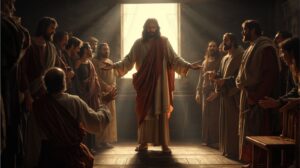
Then we come to the Gospel, the heart of this feast. It is the evening of that first Easter. The disciples are huddled behind locked doors, paralyzed by fear. Jesus comes and stands among them. His first words are not a rebuke for their cowardice, but a gift: “Peace be with you.” He shows them His hands and His side—the wounds of His passion now radiant with victory. Then He breathes on them and says, “Receive the Holy Spirit. Whose sins you forgive are forgiven them.” This is the birth of the Sacrament of Reconciliation, the very channel of Divine Mercy.
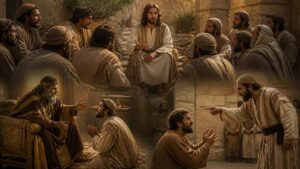
But Thomas is missing. When the others tell him, he refuses to believe. “Unless I see the mark of the nails in his hands and put my finger into the nailmarks and put my hand into his side, I will not believe.” Eight days later, Jesus returns. He goes directly to Thomas: “Put your finger here and see my hands, and bring your hand and put it into my side, and do not be unbelieving, but believe.” Thomas’s response is the most profound confession in the Gospels: “My Lord and my God!” Then Jesus speaks the beatitude for all future generations: “Blessed are those who have not seen and have believed.”
Pope Saint John Paul II, who established this feast, wrote, “Divine Mercy reaches human beings through the heart of Christ crucified.” St. Faustina, the Apostle of Divine Mercy, recorded Jesus’s words: “I desire that the Feast of Mercy be a refuge and shelter for all souls.”
For us, this Sunday is an invitation. Perhaps you are like Thomas—wounded by doubt, struggling to believe, hiding behind locked doors. Jesus comes to you. He shows you His wounds. He offers you His peace. He invites you to touch the source of mercy. And if you have already believed, you are called to become that mercy for others. The early Church had no needy among them because mercy was not just preached; it was practiced.
Let us go forth from this Eucharist as apostles of Divine Mercy. Let us forgive as we have been forgiven. Let us share as we have been blessed. And let us proclaim, with Thomas and with all the saints: Jesus, my Lord and my God, I trust in You! Amen.
May God bless you all!