
Third Sunday of Easter (A), April 19, 2026
The Fire That Burns Within
Acts 2:14.22-33, Psalm: 15, 1Pt 1:17-21, Lk 24:13-35
My dear Sisters and Brothers in Christ,
On this Third Sunday of Easter, the Church places before us a journey that is our own journey—the journey from despair to hope, from confusion to recognition, from walking away to running back. The disciples on the road to Emmaus are us. Their story is the story of every soul that has ever known disappointment and longed for the Lord to draw near.
In the Acts of the Apostles, Peter stands before the crowds on Pentecost and proclaims the definitive interpretation of all that had happened. He quotes David, who foresaw that the Messiah would not be abandoned to the grave. Peter declares with bold certainty: “God raised this Jesus; of this we are all witnesses.” The apostles are not preaching a philosophy or a moral code. They are testifying to an event—the Resurrection—that has shattered the power of death and opened a future of hope. This is the foundation of our faith: not a pious idea, but a historical reality witnessed by ordinary men and women.
Saint Peter, in his first letter, draws out the implications for how we live. “Conduct yourselves with reverence during the time of your sojourning,” he writes. Our life on earth is a journey, a passing through. And we have been ransomed not with perishable things like silver or gold, but with the precious blood of Christ, the unblemished Lamb. Peter anchors our hope in the God “who raised him from the dead and gave him glory.” Our conduct matters because our identity has changed. We are no longer our own; we have been bought with a price.
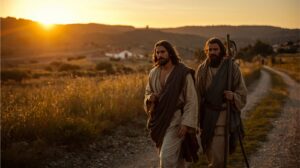
Then we come to the Gospel, the Emmaus story, which gathers all these threads into one luminous tapestry. Two disciples are walking away from Jerusalem, away from the community, away from hope. Their faces are downcast. They had believed Jesus would redeem Israel, but now He is dead, and His body is missing. They are living in the gap between the crucifixion and the resurrection, between the promise and its fulfillment.
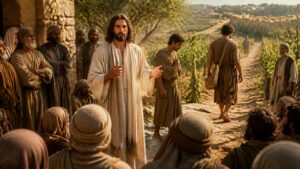
A stranger joins them and asks what they are discussing. Their question is almost bitter: “Are you the only visitor to Jerusalem who does not know the things that have taken place there in these days?” Then Jesus opens the Scriptures to them, beginning with Moses and all the prophets, explaining how the Messiah had to suffer and enter into His glory. Their hearts burn within them as He speaks.
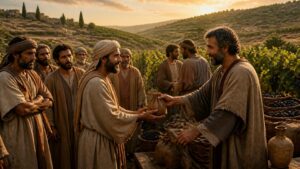
But it is only at the table, when He takes bread, blesses, breaks, and gives it to them, that their eyes are opened. In the breaking of the bread, they recognize the Risen Lord. And immediately, they return to Jerusalem. The journey of despair becomes a mission of joy. They have encountered the Lord, and they cannot keep it to themselves.
Pope Benedict XVI reflected deeply on this Gospel: “The Emmaus story is a paradigm for the Christian life. We walk in darkness, but the Lord walks with us. He opens the Scriptures to us, and in the breaking of the bread, our eyes are opened.” St. Augustine captured the essence: “We were not present when the Lord rose, but we were present when the disciples recognized Him in the breaking of the bread.”
This Easter season, the Lord walks beside us on our own Emmaus roads. When we are confused, when hope falters, when the future seems uncertain, He draws near. He opens the Scriptures to us in the liturgy. He makes Himself known to us in the Eucharist. And then He sends us back—to our families, our workplaces, our communities—with hearts burning and eyes opened.
Let us not be strangers to the breaking of the bread. Let us not be strangers to the Word that explains all things. For the Risen Lord is with us, and in His presence, despair gives way to joy, and the journey becomes a mission. Amen.
May God bless you all!