
Thursday of the Ninth Week in Ordinary Time, June 4, 2026
The Unchained Word and the Undivided Heart
2Tim 2:8-15; Psalm: 24; Mk 12:28-34
My dear Sisters and Brothers in Christ,
At the center of our faith lies a beautiful simplicity. The world complicates; God clarifies. Today, the Word of God strips away every distraction and places before us the irreducible core of the Christian life: a love so total that it embraces God and neighbor, and a hope so unshakable that it endures chains and suffering. Saint Paul, writing from a Roman prison, and Jesus, teaching in the Temple, both point us to the same liberating truth: the Word of God cannot be chained, and the heart of the Law is love.
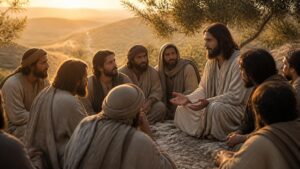
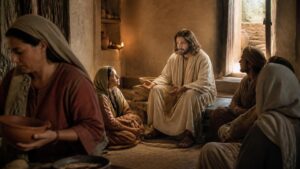
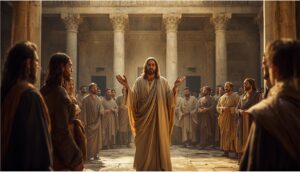
In the Gospel of Mark, a scribe approaches Jesus with a genuine question: “Which is the first of all the commandments?” Jesus answers by quoting the Shema, the daily prayer of Israel: “Hear, O Israel! The Lord our God is Lord alone! You shall love the Lord your God with all your heart, with all your soul, with all your mind, and with all your strength.” Then He immediately adds the second, from Leviticus: “You shall love your neighbor as yourself.” Jesus insists that these two are inseparable. Love of God without love of neighbor is a lie; love of neighbor without love of God is incomplete. The scribe agrees, adding a profound insight: such love “is worth more than all burnt offerings and sacrifices.” Jesus, seeing his sincerity, tells him, “You are not far from the Kingdom of God.”
In this simple exchange, Jesus gives us the compass for every moral decision, the filter for every religious practice. Does this action flow from love of God? Does it express love for my neighbor? If not, it may be a burnt offering without fire.
Saint Paul, in his second letter to Timothy, lives out this love from a prison cell. He writes, “Remember Jesus Christ, raised from the dead, a descendant of David: such is my gospel, for which I am suffering, even to the point of chains, like a criminal. But the word of God is not chained.” Paul’s body is bound, but the Gospel runs free. He has loved God with all his strength, and that love has carried him to chains and, ultimately, to martyrdom. He has loved his neighbor—Timothy, the churches, even his persecutors—by pouring out his life for their salvation.
Paul then offers a beautiful “trustworthy saying”: “If we have died with him we shall also live with him; if we persevere we shall also reign with him.” The love that unites us to Christ is not a fleeting emotion; it is a dying and rising. It is the daily choice to let go of our own way and embrace His. And it is the confidence that no chain, no suffering, no death can separate us from the love of God in Christ Jesus.
Pope Francis often reminds us, “The heart of the Gospel is mercy. It is the love of God that reaches out to us and compels us to reach out to others.” Saint Augustine, summarizing the entire Christian life, said simply, “Love, and do what you will.” When love of God and neighbor is the root, every action bears good fruit.
What does this mean for us? We are not all called to prison chains, but we are all called to the daily “chains” of fidelity: the chain of a difficult marriage, the chain of a demanding job, the chain of caring for an aging parent, the chain of resisting temptation. In these chains, the Word of God remains unchained. In these small deaths, we share in Christ’s death, and in them, we already taste His resurrection.
Today, let us stop complicating our faith. Let us return to the heart: Love God completely. Love your neighbor as yourself. And trust that the unchained Word, working through our chained lives, will bring us at last to the Kingdom where love is perfectly at home. Amen.
May God bless you all!