
Monday of the Tenth Week in Ordinary Time, June 8, 2026
The Hidden Brook and the Promised Kingdom: Trusting the God Who Provides
1Kgs 17:1-6; Psalm: 120; Mt 5:1-12
My dear Sisters and Brothers in Christ,
In the rugged wilderness east of the Jordan, a lone prophet discovers a surprising truth about God’s providence. Elijah has just pronounced a drought on the land. Now, hiding from Ahab, he must himself depend on water from a brook and bread delivered by ravens. The birds of the air—unclean, scavenging, unlikely messengers—become his daily caterers. This strange scene is a living parable of the first Beatitude: “Blessed are the poor in spirit, for theirs is the kingdom of heaven.”
In the First Book of Kings, God tells Elijah, “Leave here, turn eastward, and hide in the Wadi Cherith. You shall drink from the brook, and I have commanded ravens to feed you there.” The prophet obeys. Morning and evening, the ravens bring him bread and meat. He drinks from the brook until it dries up. This is the school of poverty. Elijah has nothing of his own—no granary, no well, no secure future. Each day, he must trust that God will send the ravens again. Each day, he experiences the truth that “man does not live by bread alone, but by every word that comes from the mouth of God” (Deut 8:3). His poverty of spirit opens him to receive the kingdom in the form of daily, miraculous provision.
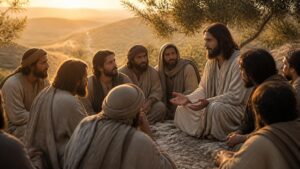
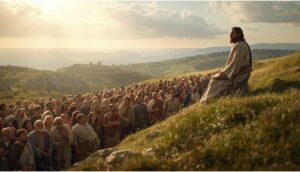
In the Gospel of Matthew, Jesus goes up the mountain and proclaims the Beatitudes. “Blessed are the poor in spirit, for theirs is the kingdom of heaven. Blessed are they who mourn, for they will be comforted. Blessed are the meek, for they will inherit the land.” This is not a checklist of virtues; it is a portrait of the disciple who, like Elijah, has learned to depend entirely on God. The poor in spirit are not necessarily the materially destitute, but those who recognize their utter need for God. They do not trust in their own resources. They do not cling to their own righteousness. They empty their hands so that God can fill them. And theirs is the kingdom—not in the future only, but already, in the hidden brook and the ravens’ bread.
Elijah mourned over Israel’s apostasy, yet he was comforted by the Lord’s presence. He was meek, hiding in the wadi rather than seizing power, yet he would inherit the land of God’s promise. He hungered and thirsted for righteousness, and God satisfied him with the justice that would later consume the prophets of Baal on Mount Carmel. The Beatitudes lived in Elijah long before Jesus spoke them.
Pope Francis, reflecting on the Beatitudes, says, “The saints are the true interpreters of the Beatitudes. They lived them with joy and courage.” Saint John Chrysostom calls the Beatitudes “the summit of virtue.” And we might add: Elijah, in his wadi, was a saint-in-training, learning that poverty of spirit is not misery but freedom.
What does this mean for us? We are not called to live by a brook or to depend on ravens. But we are called to trust God in our own “wadis”—in financial uncertainty, in loneliness, in the drying up of our usual sources of security. Each day, we must choose whether to panic or to believe that God will send bread. Each day, we can practice poverty of spirit by letting go of control, by forgiving instead of clutching resentment, by giving alms instead of hoarding.
The ravens still fly. The brook still flows, though sometimes hidden. The kingdom is already ours, not as a distant reward, but as the daily strength to trust, to mourn, to be meek, and to hunger for what is right. Let us sit by the wadi of our present need and watch for the birds of heaven. They will come. They always do. Amen.
May God bless you all!