
Tuesday of the Thirty-second Week in Ordinary Time, November 10, 2026
Duty and Grace: The Secret of Saint Leo the Great
Titus 2:1-8.11-14, Psalm: 36, Lk 17:7-10
Memorial of Saint Leo the Great, Pope and Doctor of the Church
My dear Sisters and Brothers in Christ,
What if the most powerful man in the world was also the most humble servant? Today, the Church celebrates Saint Leo the Great, the Pope who met Attila the Hun at the gates of Rome and persuaded him to turn back. He was a man of immense authority—yet he called himself, like all Popes, “the servant of the servants of God.” And the Word of God today reveals the secret of such greatness: grace, not self-promotion.
In his Letter to Titus, Saint Paul gives practical instructions for living the faith. Older men are to be temperate and reverent. Older women are to be examples. Young men are to be self-controlled. Slaves are to be trustworthy. But then Paul gives the reason: “For the grace of God has appeared, saving all and training us to reject godless ways and worldly desires and to live temperately, justly, and devoutly in this age.” Grace does not just forgive us; it trains us. It teaches us. It makes us zealous for good works. We serve not to earn salvation, but because salvation has been given to us.
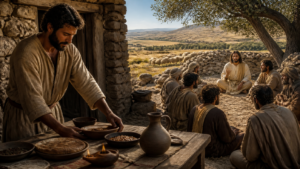
Then Jesus tells a parable that sounds almost harsh. A servant comes in from the field. Does the master say, “Come and sit at the table”? No. He says, “Prepare my supper, and serve me while I eat; you can eat afterward.” When the servant has done everything, he says, “We are unprofitable servants; we have done what we were obliged to do.” This is not a picture of an abusive God. It is a picture of honest humility. We do not serve God because He owes us a reward. We serve Him because He is God, and we are His creatures. All our service is simply our duty. And yet—here is the mystery—God in His grace chooses to reward what is already His due.
Saint Leo the Great lived this balance perfectly. He was a scholar and a statesman, a defender of the faith against heresies. His famous Tome on the two natures of Christ is a masterpiece of doctrine. He sent missionaries, reformed the liturgy, and governed the Church with wisdom. Yet he never forgot that he was a servant. When Attila threatened Rome, Leo did not rally an army. He went out to meet the invader with a cross and a message of peace. He trusted not in his own power, but in the grace of God. As he wrote in one of his sermons: “Our sharing in the body and blood of Christ tends to make us become what we receive.” He knew that all authority comes from the One who came not to be served but to serve.
Pope Benedict XVI, reflecting on Saint Leo, said, “He was a great Pope because he was a humble servant. His courage came from his faith, not from his office.” Pope Francis reminds us that “the shepherd must smell like his sheep,” and that true authority is always exercised in service.
What does this mean for us? We are not all called to meet Attila or write theological treatises. But we are all called to serve—in our families, our parishes, our workplaces. We are called to do our duty, not for applause, but because grace has appeared. We are unprofitable servants. But the God of grace makes our tiny offerings fruitful beyond measure.
Today, let us examine our hearts. Are we serving to be noticed, or because we love? Are we doing our duty with joy, or with resentment? Let us ask Saint Leo the Great to intercede for us, that we may be humble servants of a great God, trusting in grace and zealous for good works. Amen. May God bless you all!