
Saturday of the Third Week of Lent, March 14, 2026
The Heart Laid Bare
Voice over by Eliz
Hos 6:1-6, Psalm: 50, Lk 18:9-14
Dear Sisters and Brothers in Christ,
The prophet Hosea and Our Lord Jesus today unveil for us the nature of true religion—what it means to stand rightly before our God.
Hosea’s people voice a beautiful prayer: “Come, let us return to the Lord… He will heal us, he will bind our wounds.” Yet, the Lord responds with a piercing lament: “Your piety is like a morning cloud, like the dew that early passes away.” Why? Because their “return” is superficial, temporary. They seek God’s healing while withholding their hearts. They perform rituals while neglecting covenant love. God’s desire is clear: “For it is love that I desire, not sacrifice, and knowledge of God rather than burnt offerings.”
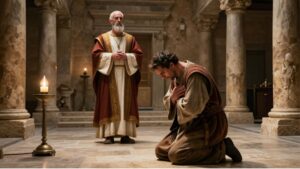
This divine diagnosis finds its perfect illustration in Christ’s parable of the Pharisee and the tax collector. The Pharisee stands assured, listing his pious achievements—fasting, tithing—and thanking God he is not like others. His prayer is a self-congratulatory monologue. The tax collector, however, “stood off at a distance and would not even raise his eyes to heaven but beat his breast and prayed, ‘O God, be merciful to me a sinner.’” Jesus’ judgment is stunning: “This man went home justified, not the other.”
Here lies the core of Catholic teaching: We are justified—made right with God—not by our own works, but by grace, received with a humble and contrite heart. The Pharisee’s error was not his good deeds, but his trust in them as a claim on God. The tax collector’s wisdom was his radical trust in God’s mercy alone. As the Catechism teaches, “Prayer restores man to God’s likeness” (CCC 2572). The tax collector’s prayer did exactly that; the Pharisee’s prayer merely reinforced his own distorted self-image.
Where is our comfort? It is immense. We do not have to perfect ourselves to approach God. We approach precisely as we are: wounded, weak, and aware of our need. Our spiritual strength comes from the truth that “everyone who exalts himself will be humbled, and the one who humbles himself will be exalted.” God resists the proud but gives grace to the humble.
St. Thérèse of Lisieux shows us the way: “I am but a weak and helpless child, yet it is my very weakness that makes me dare to offer myself, O Jesus, as a victim to Your Love.” Like the tax collector, she knew her spiritual poverty was not an obstacle to God, but the very opening through which His mercy floods in.
This week, let us examine our prayer. Is it a list of accomplishments presented to God, or a heart laid bare, trusting solely in His merciful love? In our daily actions, do we seek the external recognition of piety, or the hidden “knowledge of God” that springs from love?
Let us take our place, not at the front of our own imaginary parade, but “off at a distance,” beating our breasts, and whispering the prayer that never fails: Lord Jesus Christ, Son of the Living God, have mercy on me, a sinner. From that place of humble truth, we will know the healing Hosea promised, and go home justified. Amen.
May God bless you all!