Tuesday of the Third Week of Easter, April 21, 2026
Faith Seeking Understanding: The Bread That Satisfies
Voice over by Angeline Chue Chue
Acts 7:51–8,1, Psalm: 30, Jn 6:30-35
Memorial of Saint Anselm of Canterbury, bishop and doctor of the Church
My dear Sisters and Brothers in Christ,
On this Memorial of Saint Anselm of Canterbury, a Doctor of the Church renowned for his profound theological insight and his famous motto “faith seeking understanding,” we encounter two responses to divine revelation. One is the hardness of heart that resists the Spirit; the other is the hunger that recognizes the true Bread from heaven. Both challenge us to examine the posture of our own hearts before God.
In the Acts of the Apostles, Stephen stands before the Sanhedrin, his face radiant as an angel, delivering a blistering indictment. He traces the long history of Israel’s resistance to God’s messengers, culminating in the murder of the Righteous One. “You stiff-necked people,” he cries, “uncircumcised in hearts and ears, you always oppose the Holy Spirit.” His words cut to the core. The response is murderous rage. They drag him out of the city and stone him. As the stones fly, Stephen prays, “Lord Jesus, receive my spirit,” and asks forgiveness for his executioners. Saul, later to become Paul, approves of the killing. Here is the ultimate resistance: killing the messenger rather than heeding the message.
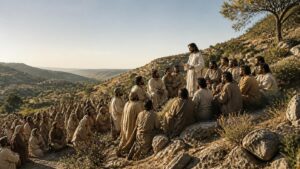
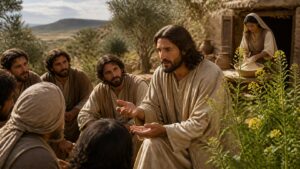
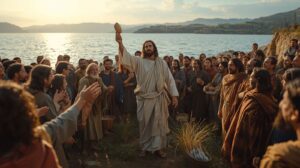
In the Gospel of John, the crowd that witnessed the multiplication of loaves now asks Jesus for a sign. They invoke the manna in the desert: “Our ancestors ate manna in the wilderness.” They want a repeat performance, a spectacle on demand. Jesus redirects their focus: “Amen, amen, I say to you, it was not Moses who gave the bread from heaven; my Father gives you the true bread from heaven.” When they ask for this bread, He reveals Himself: “I am the bread of life; whoever comes to me will never hunger, and whoever believes in me will never thirst.”
The contrast is stark. Stephen’s persecutors are “stiff-necked,” their hearts hardened against the Spirit. The crowd seeks signs on their own terms, missing the Sign standing before them. Stephen, by contrast, sees clearly. He sees the heavens opened and the Son of Man standing at the right hand of God. His faith is not seeking signs; it is seeking the One who is the Sign.
Saint Anselm lived in the tension between faith and understanding. He did not seek to prove God by human reason alone, but to understand what he already believed. His prayer captures the heart of true seeking: “Lord, grant that I may seek you, that I may desire you, that I may find you, that I may love you.” He understood that faith comes first, and understanding follows in its wake.
Pope Benedict XVI said of Anselm, “He was convinced that every believer should desire to understand the object of his own faith.” And St. Augustine, whom Anselm cherished, prayed, “I believe, to understand; and I understand, the better to believe.”
For us today, the question is this: Do we approach the Lord with the hardness of Stephen’s persecutors, resisting the Spirit’s movement? Or do we approach Him like the crowd, seeking signs for our own consumption? Or do we, like Stephen and Anselm, seek not merely to see signs, but to see the Sign—the Bread of Life who satisfies every hunger?
This Easter season, let us open our hearts to the Spirit. Let us seek not the bread that perishes, but the Bread that endures. And in that seeking, may we find, with Saint Anselm, that faith and understanding embrace, and our hearts rest in the One who is our true food. Amen.
May God bless you all!