Thursday of the Eleventh Week in Ordinary Time, June 18, 2026
The Fire of Elijah and the Simplicity of the Our Father
Sir 48:1-15; Psalm: 96; Mt 6:7-15
My dear Sisters and Brothers in Christ,
Today, the Word of God presents us with two powerful images of our relationship with the Lord. One is the prophet Elijah, who burned with zeal for God’s glory, calling down fire from heaven and wielding the word of the Lord like a flame. The other is Jesus, who teaches His disciples to pray with simple, trusting words: “Our Father who art in heaven.” Elijah’s fire and the Our Father’s intimacy are not opposites; they are two movements of the same love. The fire of Elijah prepares us for the simplicity of the child, and the simplicity of the child fuels the fire of the prophet.
The Book of Sirach sings the praises of Elijah, a prophet “whose words were a flaming furnace.” He brought famine, called down fire, raised the dead, and was taken up to heaven in a whirlwind. His zeal was fierce because his love was real. He could not tolerate the worship of false gods. He stood alone against four hundred and fifty prophets of Baal. His prayer was not a quiet whisper; it was a battle cry: “Answer me, Lord, that this people may know that you are God!” And fire fell. But Sirach also notes that Elijah was “destined to put an end to wrath before the anger of the Lord.” His fire was not destructive for its own sake; it was purifying, calling Israel back to covenant love.
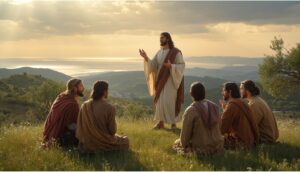
In the Gospel, Jesus gives us the Our Father. He warns against “babbling like the pagans, who think they will be heard because of their many words.” Pagan prayer was often an attempt to manipulate the gods through formulaic repetition. Jesus reveals a different way: prayer as intimate conversation with a Father who knows our needs before we ask. The Our Father is simple, direct, and trusting. It begins with the intimate “Abba” and moves through petitions for daily bread, forgiveness, and deliverance. It is the prayer of a child, not a magician. Yet this simple prayer is also a prayer of fire. When we pray “Hallowed be thy name,” we are asking that God’s name be revered as Elijah demanded. When we pray “Thy kingdom come,” we are asking for the fire of God’s justice to consume all evil. When we pray “Forgive us our trespasses,” we are asking for the purification that Elijah’s fire symbolized.
Pope Francis has said, “The Our Father is not a prayer that makes us feel comfortable; it is a prayer that makes us take responsibility for our brothers and sisters.” Saint John Paul II called the Our Father “a synthesis of the whole Gospel.” Saint Augustine wrote, “If you pray well, you pray with the Our Father; if you pray with the Our Father, you pray well.”
The connection between Elijah and the Our Father is this: both come from a heart that knows God as the only true God and longs for His will to be done. Elijah’s fire was the fire of love, not hatred. The Our Father’s simplicity is the simplicity of trust, not ignorance. We need both. We need the prophet’s courage to stand against the Baals of our age—idolatry of money, pleasure, power. And we need the child’s confidence to say, “Father, you know what I need before I ask.”
This week, let us pray the Our Father slowly, phrase by phrase, letting each petition burn away our idols. Let us ask for the spirit of Elijah: not to call down fire on others, but to ignite our own hearts with love for God. And let us remember that the same God who answered Elijah with fire answers us with the quiet certainty that we are His beloved children. For the Lord’s Prayer is not a formula; it is a relationship. And that relationship is the fire that saves. Amen.
May God bless you all!