
Saturday of the Twelfth Week in Ordinary Time, June 27, 2026

From Weeping to Wonder: The Centurion’s Faith and the City’s Lament
Lam 2:2.10-14.18-19; Psalm: 73; Mt 8:5-17
Memorial of Saint Cyril of Alexandria, Bishop and Doctor of the Church
My dear Sisters and Brothers in Christ,
On this Memorial of Saint Cyril of Alexandria, a great defender of the faith who taught us that Christ is one divine person who heals both soul and body, the Word of God leads us from the rubble of a broken city to the wonder of a humble centurion. The Book of Lamentations weeps over Jerusalem—destroyed, abandoned, her prophets silent. The Gospel of Matthew shows us a foreign soldier who understands authority better than the priests of the Temple. Both readings speak to us in our own ruins: our sins, our sorrows, our sense of exile. And both point us to the only one who can rebuild and heal.
Jeremiah’s voice cries from the ashes: “The Lord has destroyed without pity; he has torn down in his wrath.” The people are starving, the children faint in the streets, the prophets give false visions. The only counsel left is, “Cry out to the Lord! Pour out your heart like water before the Lord.” Lamentation is not despair; it is the prayer of those who refuse to pretend that sin has no consequences. The city fell because the people abandoned the covenant. The tears are honest, and honest tears are the beginning of healing.
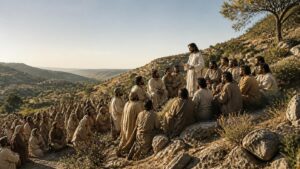
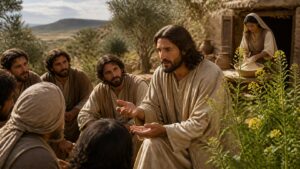
In the Gospel, a centurion approaches Jesus. He is a Gentile, a representative of the occupying power. But his servant is paralyzed, suffering terribly. He does not presume on his own merit. He says, “Lord, I am not worthy to have you enter under my roof. Only say the word, and my servant will be healed.” Jesus marvels. “Amen, I say to you, in no one in Israel have I found such faith.” Then He declares that many will come from east and west to recline with Abraham, Isaac, and Jacob in the Kingdom. And the servant is healed at that very hour.
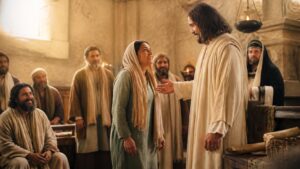
The centurion’s words are our words at every Mass: “Lord, I am not worthy…” He understood that Jesus’ authority is not limited by space or ritual. The same authority that healed the servant raised the dead and forgave sins. Then Jesus enters Peter’s house, heals his mother-in-law, and she rises to serve. His power flows into ordinary life—a fever rebuked, a meal prepared, a mission continued.
Saint Cyril of Alexandria fought fiercely to proclaim that Christ is one person, fully divine and fully human, who heals the whole person. He would not allow the church to divide Jesus into two separate beings. Against the Nestorians, he insisted: “One is the Son, our Lord Jesus Christ.” That same undivided Lord touches our divided lives. The lament of Jerusalem finds its answer in the touch of the Word made flesh.
Pope Francis, reflecting on the centurion, says, “Faith is not about having a correct theory, but about trusting in the person of Jesus.” Saint Augustine, in his commentary, wrote, “The centurion believed that the word of Christ could heal without physical presence. How much more should we believe that His word heals our souls in the Eucharist?”
What does this mean for us? We all have “Jerusalems” in ruins: relationships broken, addictions that enslave, grief that paralyzes. We can either weep without hope, or we can bring our lament to Jesus with the centurion’s humility. He says, “Only say the word.” And His word is spoken in the Gospel, in the absolution of confession, in the “This is my body” of the altar. That word has authority over every paralysis, every fever, every exile.
This week, let us pour out our hearts like water before the Lord. Let us kneel with the centurion and say, “I am not worthy.” And let us rise with Peter’s mother-in-law to serve the One whose word alone can heal the world. Amen.
May God bless you all!