
Friday of the Twelfth Week in Ordinary Time, June 26, 2026
From Exile to Healing: The Touch of Christ in Our Daily Ordinary
2Kgs 25:1-12; Psalm: 136; Mt 8:1-4
Memorial of Saint Josemaría, Presbyter
My dear Sisters and Brothers in Christ,
On this Memorial of Saint Josemaría Escrivá, the founder of Opus Dei who tirelessly preached the call to holiness in ordinary life, the Word of God presents us with two starkly contrasting scenes. One is a city in ruins; the other is a man made whole. One speaks of the wages of sin; the other proclaims the power of mercy. Through both, the Lord invites us to leave our exile—whatever its form—and to let Him touch our deepest wounds.
In the first reading, we witness the tragic end of Jerusalem. King Zedekiah rebels against Babylon, and Nebuchadnezzar besieges the city. Famine ravages the people. The walls are breached, the king flees, and the Chaldean army captures him, slaughters his sons before his eyes, then blinds him and leads him away in chains. The Temple of Solomon, the glory of Israel, is burned. The walls of Jerusalem are torn down. The people are led into exile. This is the consequence of generations of infidelity—worshipping false gods, ignoring the prophets, oppressing the poor. The house of God, which should have been a house of prayer, had become a den of thieves. Now it lies in ashes.
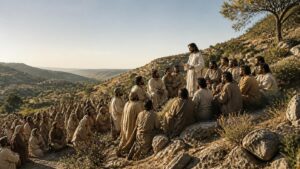
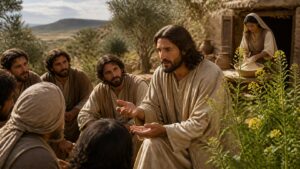
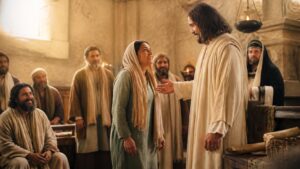
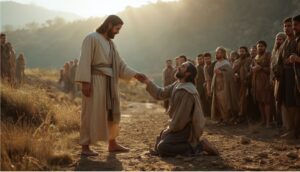
Yet in the Gospel, a different scene unfolds. A leper approaches Jesus. According to the law, he should have stood at a distance. Leprosy was a living death—exile from community, exile from worship, exile from human touch. The leper kneels and says, “Lord, if you wish, you can make me clean.” Jesus stretches out his hand, touches the untouchable, and says, “I will do it. Be made clean.” Immediately the leprosy is cleansed. Jesus then sends him to the priests, to offer the gift prescribed by Moses, “as a testimony to them.” The exile is over. The leper is restored to the Temple, to the community, to life itself.
Saint Josemaría saw in the leper’s cry a model for our own prayer: “Lord, if you wish, you can make me clean.” He taught that holiness is not reserved for a few, but is offered to every person in the midst of ordinary work, family life, and daily duties. The leper did not do anything extraordinary; he simply recognized his need and placed himself before the Lord. In the same way, we are called to bring our “leprosy”—our sins, our attachments, our spiritual paralysis—to Jesus, trusting that He wills our healing.
The fall of Jerusalem warns us that sin has consequences. It leads to exile—from God, from peace, from our true selves. But the healing of the leper assures us that God’s mercy is greater than our infidelity. The Temple was destroyed, but Jesus, the new Temple, restores what was lost. The touch of Christ cleanses what no law could purify.
Pope Francis reminds us, “God never tires of forgiving; we are the ones who tire of asking for forgiveness.” Saint Josemaría wrote, “Holiness is not for the elite; it is for everyone, for you, for me, for every soul that wants to be a saint.” And Saint John Paul II called Opus Dei “a great catechesis of holiness in the ordinary.”
This week, let us examine our own “exile.” Where have we wandered from the Lord? What leprosy do we hide? Let us kneel before Jesus in the Sacrament of Reconciliation, and hear Him say, “I will do it. Be made clean.” Then, like the leper, let us go and offer our testimony—not in the Temple alone, but in the office, the kitchen, the school, the street. For in the ordinary, the extraordinary mercy of God is waiting to touch us. Amen.
May God bless you all!