
Wednesday of the Eighteenth Week in Ordinary Time, August 5, 2026

From Exile to Embrace: The Faith That Dares to Ask
Jer 31:1-7, Psalm: Jer 31, Mt 15:21-28
My dear Sisters and Brothers in Christ,
The prophet Jeremiah speaks of a day when the Lord will restore His people. “At that time, says the Lord, I will be the God of all the tribes of Israel, and they shall be my people.” After years of exile, of wandering, of suffering, the Lord promises to rebuild. “I have loved you with an everlasting love; therefore, I have continued my faithfulness to you.” The people will return, they will sing, they will be gathered from the ends of the earth. The Lord will turn their mourning into joy and will comfort them.
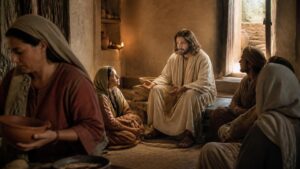
In the Gospel, a Canaanite woman—a foreigner, an outsider—cries out to Jesus, “Have mercy on me, Lord, Son of David! My daughter is tormented by a demon.” Jesus does not answer her at first. The disciples urge Him to send her away. He says, “I was sent only to the lost sheep of the house of Israel.” But she persists. She worships Him and says, “Lord, help me.” He answers, “It is not right to take the food of the children and throw it to the dogs.” She replies, “Please, Lord, for even the dogs eat the scraps that fall from the table of their masters.” Jesus says, “O woman, great is your faith! Let it be done for you as you wish.” Her daughter is healed.
Jeremiah’s prophecy of restoration is a promise to the exiles, to those who had been cast out. The Canaanite woman is an exile in her own land, a foreigner seeking the mercy of Israel’s God. She does not demand; she begs. She does not claim a right; she pleads for a scrap. And Jesus, who seemed to ignore her, who seemed to reject her, grants her request because of her great faith. The “children’s bread” becomes a feast for the outsider.
Pope Francis has said, “The Canaanite woman teaches us the virtue of perseverance in prayer. She does not give up, even when she seems to be rejected.” Saint John Chrysostom, reflecting on this Gospel, wrote, “She was a woman of great faith, who would not be silenced by rejection. She knew that the mercy of God is greater than any boundary.” And Saint Augustine, contemplating the prophecy of Jeremiah, said, “The Lord’s love is everlasting. He does not abandon His people, even when they are in exile.”
What does this mean for us? We are the exiles, scattered by sin, wounded by suffering. We are the Canaanite woman, outsiders who have no claim on God’s mercy. But the promise of Jeremiah is for us: God will restore us. He will turn our mourning into joy. And the Canaanite woman shows us the way: persistent faith, humble begging, the refusal to be silenced by rejection. We come to Jesus not because we deserve His help, but because He is merciful. We do not demand; we beg. We do not claim a right; we ask for a scrap.
This week, let us not be afraid to cry out to the Lord. Let us not be discouraged if the answer seems slow or the silence seems long. Let us persist in prayer, trusting that the Lord who restores the exiles will hear our cry. And let us be like the Canaanite woman, whose faith was not in her own worthiness, but in the goodness of the Master. For the Master has come to gather the exiles, to heal the broken, and to feed all who hunger for Him. Amen.
May God bless you all!
If this homily inspired you, please
📱 Follow us on TikTok: @mmrvals
📺 Subscribe on YouTube: Myanmar RVA Language Services – YouTube
🙏 Prayer Request: Drop a comment below if you’d like us to pray for you or someone you love. We’ll remember you in our prayers!