
Monday of the Twenty-sixth Week in Ordinary Time, September 28, 2026
The Suffering Servant and the Child: Finding Greatness in Humility
Job 1:6-22, Psalm: 16, Lk 9:46-50
Memorial of Saint Wenceslaus, Martyr
My dear Sisters and Brothers in Christ,
On this Memorial of Saint Wenceslaus, a holy king and martyr who gave his life for the faith, the Church presents us with a profound and challenging teaching. The Book of Job reveals the mystery of innocent suffering. The Gospel shows us the true nature of greatness. Saint Wenceslaus, the “Good King Wenceslaus,” embodied both: he suffered unjustly, and he sought greatness not in power, but in humility and service.
In the Book of Job, we witness a scene that is both cosmic and deeply personal. The Lord, in His sovereign majesty, permits Satan to test Job’s faithfulness. Job loses his oxen, his donkeys, his sheep, his camels, his servants, and finally his sons and daughters. In the face of unspeakable tragedy, Job does not curse God. He tears his robe, shaves his head, and falls to the ground in worship. He says, “Naked I came from my mother’s womb, and naked I shall return there. The Lord gave, and the Lord has taken away; blessed be the name of the Lord!” Job’s faith is not a fair-weather faith; it is a faith that clings to God even in the darkness. It is a faith that knows that God is God, and we are not.
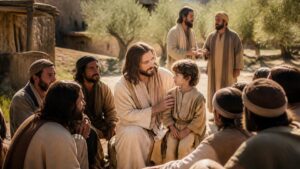
In the Gospel of Luke, the disciples are arguing about who among them is the greatest. Jesus, knowing their thoughts, takes a child and places him by His side. He says, “Whoever receives this child in my name receives me, and whoever receives me receives the one who sent me. For the one who is least among all of you is the one who is the greatest.” Jesus turns the world’s understanding of greatness upside down. Greatness is not found in power, prestige, or position. It is found in humility, in service, in the willingness to become like a child—dependent, trusting, and open.
Saint Wenceslaus lived this Gospel. He was a king, but he did not use his power for his own advantage. He was a man of prayer, a man of charity, a man of justice. He cared for the poor, he protected the Church, and he sought peace. He was murdered by his own brother, a victim of political intrigue and familial betrayal. He died for the faith, a martyr for Christ. His greatness was not in his crown, but in his humility.
Pope Benedict XVI, reflecting on the mystery of suffering, said, “The Cross is the revelation of God’s love, the definitive proof that He loves us to the end.” And Saint Augustine, contemplating the child in the Gospel, wrote, “The one who is least among you is the one who is greatest. Humility is the way to exaltation.”
What does this mean for us? We are called to embrace the mystery of suffering, to trust in God’s goodness even when we do not understand. We are called to seek greatness not in power, but in humility and service. We are called to be like Job, who blessed God even in his sorrow. We are called to be like Saint Wenceslaus, who gave his life for the faith.
Today, let us examine our hearts. Are we seeking greatness in the eyes of the world, or in the eyes of God? Are we willing to embrace suffering and trust in God’s providence? Let us ask the Lord to give us the grace to be humble, to be faithful, and to be willing to give our lives for the sake of the Gospel. Amen.
May God bless you all!