
“Prayers Can Still Help”: Kengtung Bishop Explains Purgatory at All Souls’ Mass
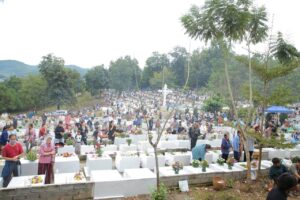
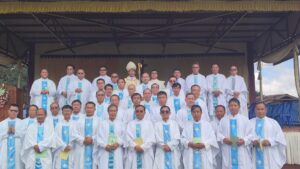
Hundreds of faithful gathered at Guardian Angel Cemetery in the Diocese of Kengtung on November 8, 2026, to pray for the souls of the departed. Bishop John Saw Yaw Han of Kengtung diocese presided over the Mass, joined by priests, nuns, and lay faithful.
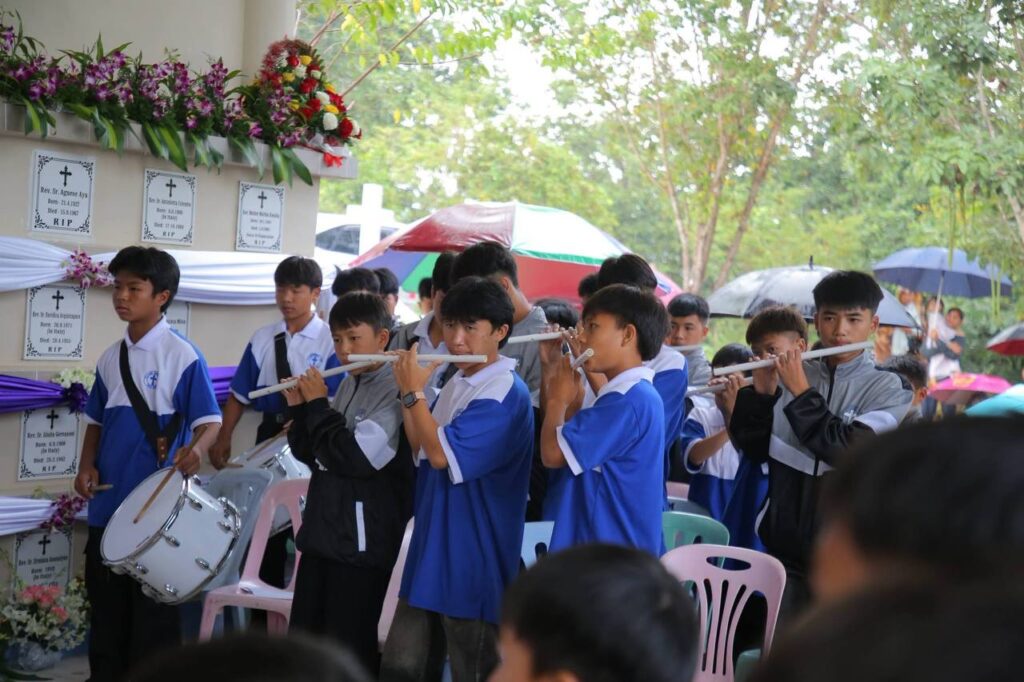
The service began with the recitation of the Rosary, the praying of Psalms, and the singing of “Libera me, Domine.” Hymns were performed with drums and flutes, along with the choir.
At the start of the Mass, Bishop John shared the historical background of praying for the dead. He explained that this practice in the Catholic Church began as early as the Old Testament period, citing 2 Maccabees 12:42–46.
He also mentioned that the Council of Trent in 1563 confirmed that souls suffering in Purgatory have the opportunity for deliverance, and that the living can offer effective help by requesting and praying Masses for them.
The Bishop clearly stated the purpose of the day: everyone had gathered to intercede before God for the souls of deceased grandparents, parents, siblings, and friends. He said that if these souls are still undergoing purification, the prayers are offered so they may attain prompt release and reach the heavenly bliss prepared by God. They also prayed for the intentions of all participants.
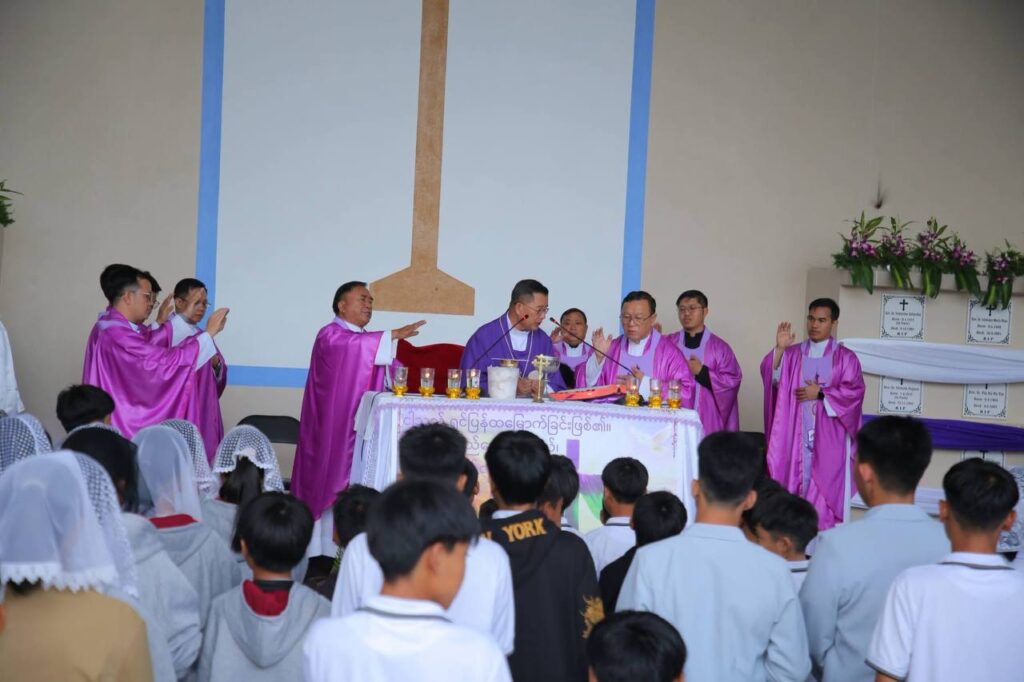
In his homily, Bishop John explained that the faithful of the Catholic Church believe in the existence of Heaven, Hell, and Purgatory.
Citing Revelation 21:27, he said that nothing unclean or detestable will enter the city, but only those whose names are written in the Lamb’s Book of Life. He explained that when a person dies, only those completely free from sin and in a state of grace can enter Heaven as saints. These saints are with God, beholding Him as He is, and no longer need our prayers.
Regarding Hell, Bishop John referenced Matthew 13:41–42, describing it as a fiery furnace—a place of weeping and gnashing of teeth—for those who do not repent of their sins.
Citing 1 Timothy and Revelation 14:11, he said they will be tormented with fire and sulfur, and the smoke of their torment rises forever. He stressed that eternal damnation burns without limit, and the inability to see the face of God is the most severe punishment.
Referencing the parable of the rich man and Lazarus in Luke 16:19–31, he explained that a deep chasm separates them, making it impossible to cross over. Therefore, those who fall into eternal Hell suffer continuous heat without any possibility of deliverance, and prayers can no longer be offered for them.
Regarding Purgatory, the Bishop explained at length that it is a place of purification and deliverance for souls not yet ready to enter Heaven—specifically those who repented and performed acts of penance in this world but passed away with remaining sins to be cleansed.
Because some souls must undergo purification for a long time—either because their past transgressions were heavy or because their venial sins were not fully cleansed—the living can help them gain deliverance through prayers, good deeds, and almsgiving. In turn, when these souls are liberated and enter the Kingdom of Heaven, they intercede for us.
The service concluded with all attendees devoutly participating in the celebration of the Holy Mass.
For the faithful of Kengtung, the day was a reminder that death does not sever the bonds of love. Through prayer and the Mass, they continue to walk with their departed loved ones, trusting in God’s mercy and the hope of eternal life.
By RVA Akha Service