
Thursday of the Twenty-second Week in Ordinary Time, September 3, 2026
The Wisdom of Foolishness and the Depths of Trust: A Homily for the Memorial of Saint Gregory the Great
1Cor 3:18-23, Psalm: 23, Lk 5:1-11
Memorial of Saint Gregory the Great, Pope and Doctor of the Church (White)
My dear Sisters and Brothers in Christ,
On this Memorial of Saint Gregory the Great, a Pope and Doctor of the Church who embraced the title “Servant of the Servants of God,” we are invited to contemplate a profound paradox at the heart of the Gospel. Saint Paul challenges us to become “fools” in the eyes of the world so that we may become truly wise. In the Gospel, Simon Peter, a professional fisherman, is told by a carpenter to lower his nets into the deep water—a command that defies all human logic. Both readings call us to the same radical trust: the wisdom of God is revealed not in human cleverness, but in humble obedience.
In the First Letter to the Corinthians, Saint Paul writes, “Let no one deceive himself. If anyone among you considers himself wise in this age, let him become a fool, to become wise.” The wisdom of the world is self-referential; it seeks to possess, to control, and to understand everything on its own terms. But the wisdom of God is a gift. It is received, not achieved. It is the knowledge that we are not the masters of the universe, but beloved children of the Father. “All things are yours,” Paul declares, “and you are Christ’s, and Christ is God’s.”
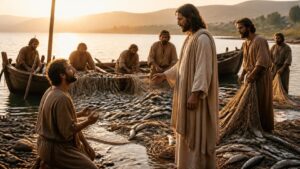
In the Gospel of Luke, Jesus steps into the boat of Simon Peter and asks him to put out into the deep water. Peter, the expert, objects: “Master, we have worked hard all night and have caught nothing.” Yet he adds, “But at your command I will lower the nets.” The result is a catch so large that the nets are tearing. Peter falls to his knees and cries out, “Depart from me, Lord, for I am a sinful man.” Peter was right: he was a sinful man, but he was also a man whom the Lord had just called to a new mission. He had tried his own way and failed. He trusted Jesus’ word and succeeded beyond his wildest imagination.
This is the great lesson of Saint Gregory the Great. He was a man of immense administrative talent, a former prefect of Rome. But he left the world behind to become a monk. He was called out of the monastery to serve as Pope against his will, and he embraced the office with humility, calling himself the “Servant of the Servants of God.” He did not rely on his own wisdom; he trusted in the wisdom of Christ.
Pope Benedict XVI, reflecting on Saint Gregory, said, “He was a man of profound humility, who always considered himself the least of the servants of God.” Pope Francis has said, “The true power of the Church is not in its structures, but in the humility of its service.” And Saint Gregory himself wrote, “The proof of love is in the works. Where love exists, it works great things. But when it ceases to act, it ceases to exist.”
What does this mean for us? We are called to put out into the deep water. We are called to trust in the command of Christ, even when our own efforts have failed. We are called to embrace the “foolishness” of the Gospel, which is the true wisdom of God. We are called to serve, not to be served. We are called to be like Saint Gregory, who found his greatness in his humility.
This week, let us examine our hearts. Where are we relying on our own wisdom? Where are we afraid to put out into the deep? Let us ask for the grace to trust in the word of Christ, to become fools for His sake, and to serve with the humility of the Servant of the Servants of God. Amen.
May God bless you all!