
Tuesday of the Thirty-third Week in Ordinary Time, November 17, 2026
The Knock, the Tree, and the Open Door: A Homily for Saint Elisabeth of Hungary
Rev 3:1-6.14-22, Psalm: 14, Lk 19:1-10
Saint Elizabeth of Hungary (White)
My dear Sisters and Brothers in Christ,
What would it take for you to open the door of your heart to Jesus? What would it take for you to stop hiding behind your busyness, your reputation, or your possessions and finally let Him in? Today, the Word of God presents us with two powerful invitations. One is spoken to a lukewarm church. The other is lived out by a hated tax collector. And both point to the same truth: Jesus is knocking. The question is: Will you open the door?
In the Book of Revelation, Jesus speaks to the church in Laodicea with words that should unsettle us all. “I know your works; you are neither cold nor hot. I wish you were either cold or hot. So, because you are lukewarm, neither hot nor cold, I will spit you out of my mouth.” Lukewarmness is the spiritual disease of comfort. It is not rejection. It is not hostility. It is indifference. It is a heart that has grown too comfortable with the world to be on fire for God. But then Jesus says something stunning: “Behold, I stand at the door and knock. If anyone hears my voice and opens the door, I will enter his house and dine with him, and he with me.” The Lord of the universe stands at the door of our hearts and waits. He knocks. He does not break the door down.
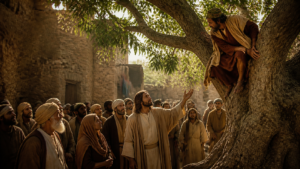
In the Gospel of Luke, we meet Zacchaeus. He was a chief tax collector, a man who had grown rich by cheating his own people. He was despised. He was rejected. He was an outcast. But when he heard that Jesus was passing by, he ran ahead and climbed a sycamore tree just to catch a glimpse of Him. Jesus looked up and said, “Zacchaeus, come down quickly, for today I must stay at your house.” And Zacchaeus came down at once and received Him with joy. The crowd grumbled. But Zacchaeus repented. He promised to give half his possessions to the poor and to repay fourfold anyone he had extorted. Jesus declared, “Today salvation has come to this house… For the Son of Man has come to seek and to save what was lost.”
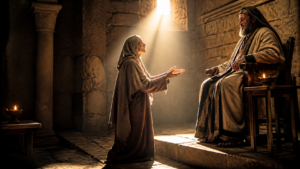
Saint Elizabeth of Hungary understood this. She was a princess by birth, a queen by marriage, but a servant by choice. When her husband died, she was cast out by his family. She gave away her wealth. She built a hospital. She cared for the sick and the poor with her own hands. She opened the door of her heart to Christ, and her life became a feast of love for the least. She died at twenty-four, consumed by her charity.
Pope Francis has said, “The Lord stands at the door and knocks. He does not force the door. He waits for us to open it.” Saint John Paul II, reflecting on the call to conversion, wrote, “Open the door to Christ. Do not be afraid.” And Saint Elisabeth herself reminds us, “The poor are the members of Christ. They are the door through which we enter eternal life.”
What does this mean for us? Have we grown lukewarm? Have we locked the door of our hearts because we are afraid of what Jesus will ask? Are we like the church of Laodicea, comfortable and unresponsive? Or are we like Zacchaeus, willing to climb a tree, to look foolish, to be transformed by a single encounter with Christ? Are we willing to open the door and let Him in, knowing that He will not enter as a harsh judge, but as a loving Lord? And are we willing to let Him dine with us—to let Him touch every part of our lives, our homes, our finances, our relationships?
Today, let us examine our hearts. Is there a door that we are keeping shut against Christ? Is there a “Zacchaeus” in our lives—a person we have written off, who is actually seeking the Lord? Let us ask Saint Elisabeth of Hungary to intercede for us, that we may have her radical love for the poor, her cheerful repentance, and her open door. For the Lord is knocking. And the one who opens the door will be welcomed into a feast of eternal joy. Amen. May God bless you all!