
Wednesday of the Thirteenth Week in Ordinary Time, July 1, 2026
Let Justice Roll Down: The Exorcism of Empty Worship
Amos 5:14-15.21-24; Psalm: 49; Mt 8,28-34
My dear Sisters and Brothers in Christ,
Two scenes unfold before us today. One is a prophet standing at the gates of Israel, denouncing religious spectacle. The other is a possessed man, wild and chained, living among tombs. Both are held captive—one by the illusion of piety, the other by a legion of demons. Both need liberation. And both reveal that true worship is not about songs and offerings, but about justice and mercy.
The prophet Amos speaks God’s words with fire. “Seek good and not evil, that you may live.” He warns the people not to long for the “day of the Lord,” because for those who oppress the poor and pervert justice, that day will be darkness, not light. Then comes the stunning indictment: “I hate, I despise your feasts… Even though you offer me your burnt offerings and grain offerings, I will not accept them.” God is not against worship; He is against worship that is disconnected from righteousness. “Let justice roll down like waters, and righteousness like an ever-flowing stream.” The river of God’s mercy cannot be contained by ritual alone; it must flood the valleys of our daily lives.
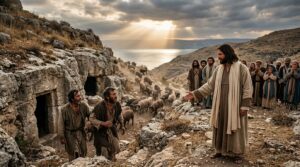
In the Gospel, Jesus steps onto the shore of the Gadarenes and is met by two demoniacs, so violent that no one could pass that way. The demons cry out, “What have you to do with us, Son of God? Have you come here to torment us before the time?” Jesus commands them to come out, and they enter a herd of swine. The swine rush into the sea and drown. The people of the town, afraid of this power they cannot control, beg Jesus to leave.
The possessed man was a picture of the human condition—broken, isolated, self-destructive. The “legion” of demons represents the many idols that enslave us: greed, pride, lust, anger. The swine, unclean animals for the Jews, symbolize the false systems of worship that Amos condemned. The people of the town preferred their pigs (their commerce, their comfort) to the presence of the One who could truly set them free.
Pope Francis has often denounced “spiritual worldliness,” the temptation to reduce faith to a set of observances while ignoring the cry of the poor. He says, “When we go to Mass and then ignore the hungry, our worship is a lie.” Saint John Chrysostom, commenting on Amos, wrote, “God does not need your sacrifices; He needs your heart.” And Saint Augustine, reflecting on the Gadarenes, noted that they “chose their swine over their Savior.”
What does this mean for us? We must examine our own worship. Do we come to Mass only to check a box, then leave indifferent to the neighbor in need? Do we pray the Rosary but harbor grudges? Do we receive Communion while refusing to forgive? Amos calls us to let justice roll down like waters—to let our faith become a river that irrigates the dry ground of our relationships, our work, our society.
The demons fled at Jesus’ word. The man was clothed and in his right mind. The same Lord who cast out the legion is present in the Sacrament of Reconciliation, ready to exorcise our own “legions” of sin. Let us not send Him away. Let us welcome Him. And let our worship be true: a life of justice, mercy, and humble trust. Then the river will flow, and we will be truly free. Amen.
May God bless you all!