
Monday of the Eighteenth Week in Ordinary Time, August 3, 2026
The Yoke of Truth and the Bread of Life
Jer 28:1-17, Psalm: 118, Mt 14:13-21
My dear Sisters and Brothers in Christ,
The prophet Jeremiah and the Lord Jesus confront two different forms of deception. Hananiah, a false prophet, speaks words of comfort that are pleasing to the ears but destructive to the soul. He declares that within two years, the Lord will break the yoke of Babylon and restore the Temple vessels. Jeremiah, the true prophet, warns that the yoke of Babylon is not a wooden yoke to be broken, but an iron yoke that will not be removed. The people must accept their punishment and repent. Hananiah preaches a false peace; Jeremiah preaches a hard truth.
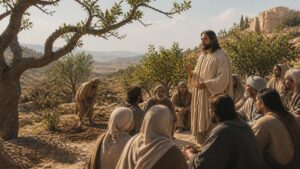
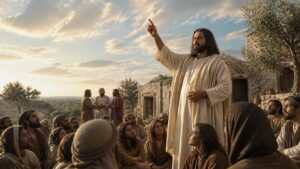
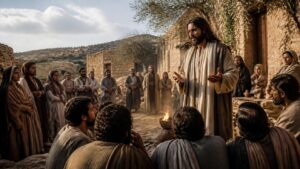
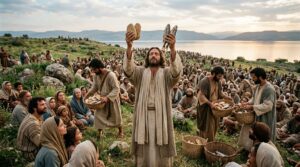
In the Gospel, Jesus withdraws to a deserted place, seeking solitude after hearing of John the Baptist’s death. But the crowds follow Him. He does not send them away; He has compassion on them and heals the sick. Evening comes, and the disciples, practical and anxious, say, “Send the crowds away to go into the villages and buy food for themselves.” Jesus answers, “They need not go away; you give them something to eat.” The disciples have only five loaves and two fish. Jesus blesses them, breaks them, and gives them to the disciples to distribute. All are fed, and twelve baskets of leftovers remain.
Hananiah promised a quick fix, a comfortable solution. But his prophecy was a lie. Jeremiah offered the hard path of repentance and acceptance of God’s will. Jesus offers the true bread—not a quick fix, but a banquet that satisfies the deepest hunger. The disciples, like Jeremiah, had to face the impossible: five loaves and two fish for a crowd of thousands. They had to trust the Lord’s command and His provision. The miracle was not just the multiplication of bread; it was the transformation of the disciples from anxious servants to generous distributors.
Pope Francis has said, “The prophet Jeremiah teaches us that the truth is not always comfortable, but it is always liberating.” Saint John Paul II, in his encyclical Redemptoris Missio, wrote, “The Church does not offer a message of comfort to those who are already comfortable; she proclaims the Gospel to all, especially to the poor.” And Saint Augustine, reflecting on the feeding of the multitude, said, “The Lord could have created bread out of nothing, but He chose to use the loaves the disciples offered, because He wants us to be participants in His work.”
What does this mean for us? We are constantly tempted by false prophets—voices that promise quick fixes, easy solutions, and comfortable Christianity. We want a faith that does not cost us anything. But Jeremiah reminds us that the path of truth often passes through the valley of repentance. We are also tempted to look at our own resources and say, “We have so little; we cannot make a difference.” But Jesus takes our small offerings—our time, our talent, our love—and multiplies them when we place them in His hands.
This week, let us examine our hearts. Are we listening to false prophets who promise peace without repentance? Are we holding back our meager offerings because we think they are not enough? Let us trust the Lord, who provides for His people even in the desert. Let us receive the true Bread from His hands, and let us become bread for the hungry. Amen.
May God bless you all!
🌟 Want to See More Videos Like This? 🌟
If this homily inspired you, please LIKE, SHARE, and SUBSCRIBE to our channel! Your support helps us bring the Word of God to more people around the world. Don’t forget to hit the notification bell 🔔 so you never miss a new video!
📱 Follow us on TikTok: @mmrvals
📺 Subscribe on YouTube: Myanmar RVA Language Services – YouTube
🙏 Prayer Request: Drop a comment below if you’d like us to pray for you or someone you love. We’ll remember you in our prayers!