
Twenty-eighth Sunday in Ordinary Time (A), October 11, 2026
The Feast of Generosity and the Garment of Grace: Accepting the King’s Invitation
Isa 25:6-10a, Psalm: 22, Phil 4:12-14.19-20, Mt 22:1-14
My dear Sisters and Brothers in Christ,
The prophet Isaiah gives us a vision of a banquet that speaks to the deepest longings of the human heart—a feast of rich food and choice wines, a celebration where the veil of sorrow is removed and every tear is wiped away. Saint Paul writes from a prison cell, declaring that he has learned the secret of contentment in every situation, finding strength in the One who empowers him. And in the Gospel, Jesus tells a parable of a wedding feast—a banquet offered to all, but one that demands a response of humble gratitude.
In the Book of Isaiah, the Lord promises a feast for all peoples, “a feast of rich food and choice wines, juicy, rich food and pure, choice wines.” This is not a celebration for the few; it is a feast for all people. God will destroy the veil that veils all peoples and the web that is woven over all nations. He will wipe away the tears from every face. This is the promise of salvation. It is the promise of joy, of abundance, of the complete restoration of all things.
Saint Paul, in his Letter to the Philippians, writes from prison, yet he speaks of contentment. “I know how to live in humble circumstances; I know also how to live with abundance.” Paul had learned the secret of contentment: “I can do all things through him who strengthens me.” His contentment was not based on his circumstances; it was based on his relationship with Christ. He trusted that God would supply all his needs according to His riches in glory. This is the posture of the one who has accepted the invitation to the feast—a posture of trust, of gratitude, of complete dependence on God.
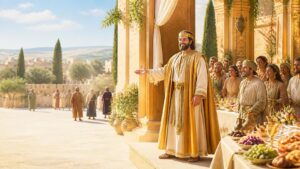
In the Gospel of Matthew, Jesus tells a parable of a king who prepared a wedding feast for his son. He sent his servants to invite the guests, but they refused to come. He sent other servants, but they ignored the invitation and mistreated the servants. The king was angry and sent his army to destroy them. Then he said, “Go out into the main roads and invite to the feast whomever you find.” The servants gathered all they found, both bad and good. But one guest was not wearing a wedding garment. He was thrown out into the darkness. The parable is a warning: the invitation is open to all, but it demands a response.
The wedding garment is the garment of grace. It is the righteousness of Christ, freely given to those who accept the invitation. It is not a garment we can earn; it is a garment we must receive. The guest who refused to wear it was rejecting the generosity of the king. He wanted to come to the feast on his own terms, but the feast is only on the king’s terms.
Pope Benedict XVI, reflecting on this parable, said, “The wedding garment is the love of God, which we must put on like a new life.” Pope Francis has said, “The Lord invites us to the feast, but He also gives us the garment we need to enter. It is the garment of mercy, of forgiveness, of love.” And Saint Augustine, contemplating the feast of Isaiah, wrote, “The Lord has prepared a feast for us, a feast of joy and abundance. Let us not refuse the invitation.”
What does this mean for us? We are invited to the feast. We are invited to the joy of salvation, the abundance of God’s grace, the promise of eternal life. But we must respond. We must put on the wedding garment of grace. We must accept the invitation with humility, gratitude, and trust. We must be like Paul, content in all circumstances, knowing that the Lord will supply all our needs. We must be like the guests who accepted the invitation, not like those who refused or the one who came without the garment.
Today, let us examine our hearts. Have we accepted the invitation to the feast? Are we wearing the wedding garment of grace? Are we content in all circumstances, trusting in the Lord’s provision? Let us ask the Lord to give us the grace to accept His invitation, to put on the garment of righteousness, and to enter into the joy of His feast. Amen.
May God bless you all!