Wednesday of the Thirty-third Week in Ordinary Time, November 18, 2026
The Throne and the Talents: Worship That Bears Fruit
Rev 4:1-11, Psalm: 150, Lk 19:11-28
Saint Odo, Abbot of Cluny
My dear Sisters and Brothers in Christ,
What do you see when you close your eyes and think of heaven? Today, Saint John pulls back the curtain. He sees a throne, a rainbow like emerald, twenty-four elders casting down their crowns, and four living creatures crying out, “Holy, holy, holy is the Lord God almighty.” It is a scene of ceaseless worship. But then Jesus tells a parable about servants who are given ten gold coins and told to “engage in trade” until the master returns. Worship and work. The throne and the talents. Are they opposed? No. They are two sides of the same coin.
In the Book of Revelation, the elders fall down before the One seated on the throne and sing, “Worthy are you, O Lord our God, to receive glory and honor and power, for you created all things.” Their worship is not passive. It is an act of homage, a recognition that everything comes from God. But notice what they do with their crowns: they cast them before the throne. They do not cling to their own glory. They return it to the source.
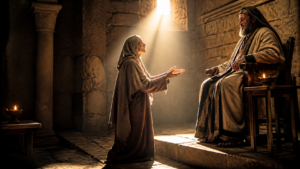
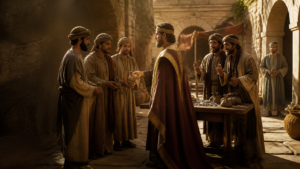
In the Gospel of Luke, a nobleman goes off to obtain a kingdom. Before leaving, he gives ten servants ten gold coins each and says, “Engage in trade until I return.” When he comes back, he calls them to account. The first servant has made ten more. The second, five more. Both are praised: “Well done, good servant.” The third kept his coin hidden in a cloth. He feared the master. He did nothing. And he is rebuked: “You wicked servant! Why did you not put my money in the bank?”
Saint Odo, the great abbot of Cluny, understood this balance. He was a man of profound prayer, spending hours before the altar, contemplating the throne of God. But he was also a reformer, a builder, a man who engaged in the “trade” of monastic life—founding monasteries, reforming abuses, and renewing the Church. He did not hide his talents. He invested them in the Kingdom. Under his leadership, Cluny became the spiritual heart of Europe.
Pope Benedict XVI, reflecting on the liturgy, said, “The worship of God is the first and most important thing. But true worship leads to mission. It sends us out to bear fruit.” Saint John Paul II, in his encyclical Novo Millennio Ineunte, wrote, “The Eucharist is the source and summit of the Christian life. It must also be the source of our mission.” And Saint Odo himself prayed, “Lord, let me not merely gaze upon your throne, but let me work for your Kingdom until you return.”
What does this mean for us? We are the servants. God has given each of us a “gold coin”—our time, our talents, our faith, our very lives. He expects us to invest them, not bury them. He expects our worship to overflow into action. The elders cast their crowns before the throne. We must cast our lives into the world, for His glory.
Today, let us examine our hearts. Are we hiding our coin in a cloth? Are we afraid to invest ourselves in the mission of the Church? Let us ask Saint Odo to intercede for us, that we may be people of both worship and work, of prayer and mission, until the Master returns and we hear the words, “Well done, good servant.”
For the King is coming back. And the question is not whether we have been busy. The question is whether we have been faithful. Amen. May God bless you all!